The reality that this post, which I meant to write with all good intentions weeks ago, has now come to feature prominently on the first of the new year may belie the constitution with which I made the resolution to post more frequently. Broken resolutions aside, this post is meant to be a summation of the year past, a review of the body of time referred to shortly as twenty eleven.
As a consequence of my birthday, the revolution of the Earth around the sun from one January to the next has always paralleled fairly closely with the passing of my age, give or take 24 days. The result has been that every year gets a defined age value, a set denomination of my longevity for every wall calendar purchased. As it turns out, the age for 2011 was twenty-three, which was, as the old idiom goes, effectively the prime of my life.
Now I say this affectionately, as it is inherently based on a corny joke that I continued to make throughout the duration of the year. If you, like me, possess a rudimentary knowledge of baseline public school math, then the concept of prime numbers (those which can only be divided by themselves and one) is something that you know of, if not have forgotten as it lost its need to be retained in the real world.
Now by no means is twenty-three the first time in my life that I was prime, as 2, 3, 5, 7, 9, 11, 13, 17 and 19 may take offense if I was so inclined to exclude them offhand. Yet, I will say that it is the first time I've been so outside the range of the milestone birthdays, which can be defined as any increase in age that earns you the right to a societal privilege. Compound onto my bad joke that 2011 was the first time I really felt like I was living my life how I wanted to, and the true reason for the goofy pun emerges: in a year that was hallmarked by economic crisis and the death of countless evil societal figures, I finally reached an operational baseline for my existence that I was content with; my prime.
The year began with Africa, which introduced me to the harsh reality of the world outside the west. A world that desperately wants to join the future, grasps at new technology, but implements and relies on it without the infrastructure or resources to make it dependable. A world easy to forget, where your dollar a day builds a water pump or school that goes derelict in a year when they run out of money to pay the upkeep. I was put in a place where consumerism couldn't be viable, lived in it, with it, adapted to it and then wrestled with my own conscience as I returned home to slip back into old habits. I realized how weak people are when faced with comfort, how weak I am when faced with what's easy, and hoped that acknowledgement of a problem is the first step to a solution. Twenty-eleven was a year of shifting comfort zones, from home to the extreme, and then back in a blink of an eye. I won't bore you here with stories out of Africa; there are many posts dedicated to that trip that are easy to access and give you a better idea of my attitude at the time.
The second half of the year was a stark contrast to the preceding months, and predominately featured me jumping through the hoops to lock down another piece of my hazy and steadily shifting future. It was a time of relative ease, relative fitness and emotional annoyance. The end result however proved to be fruitful, and those fruits have turned out to be a job in Japan, one of the things I listed as a thing to do on my very first blog entry.
In past posts I'd been relatively shady as far as details, and as my last real post was on the eleventh of November, it was mainly because I had no real details on which to speak. With December came a job offer, and in this coming February I will be flying to Nagoya, and beginning my contract as a teacher of English for ECC second language institutes. Although I had made it clear that I was flexible in my placement, Nagoya was my subconscious number one in terms of cities to go to, and I can honestly say that I was thrilled to be so lucky. As a transit hub to the country, Nagoya exists as the industrious, laid-back, financial capital to Japan.
To be honest, I should probably be more scared. I've cast around for ideas as to why I'm so calm in the face of such a drastically life changing experience, and the closest I can figure is that I am all worried out. Between the time I spent freaking out over Africa, and the time I spent asking myself countless 'what-ifs' during my first round of interviews with ECC in the spring of 2010, I have effectively exhausted the amount of time I can spend worrying over traveling and Japan in general. My immediate future is locked, and I'm along for the ride. There is no malicious intent in this universe, just a way of things, and if you worry or don't worry about something, things will happen the same regardless. It is a lot easier to cope with existence when you assume that nothing is out to get you.
My goal for this blog in 2012 is to become a lot more active. Writing has become this great release for me, and I always kick myself for taking too long between posts. For letting good ideas come and leave without even giving them a chance to be written down. Maybe not over the next two months, but hopefully after I arrive in Japan, this blog will become a bit more of a daily activity. More of a play by play than a monthly memoir of an event or a feeling.
So with a freshly written post, a form that gives me a clean bill of health, and a list of so many other things I need to get done in the next two months, I'll leave you with a song that I've been singing today and wrote this post to,
Thanks so much for reading and for your patience with me,
Much Love and Happy New Year!
Sean
As a note, here is the list from my first post 'A Gratuitous Introduction':
- Teach English in a foreign country. I may have been turned down for Japan, but Korea may be in my future - and experience breeds opportunities later.
- Tree plant in Western Canada. Despite all the people telling me why I shouldn't do this, the few that had the guts to tell me why I should had much more convincing arguments.
- Somehow traverse a country by WWOOFing at different locations as I go along. Meet the people, save the planet.
- Go to Japan. I WILL be in Japan soon. Man I want to go there so bad. And as a tack on I want to backpack Asia as well.
- Volunteer in Africa. I am currently waiting to hear back on a position I applied for. Things looks good. And perhaps climb Mt. Kilamanjaro while there.
- Work Visa in Australia. The visa costs $200, the experience lasts me forever.
Looks like I'll go three for six shortly, not bad!
Showing posts with label Uganda. Show all posts
Showing posts with label Uganda. Show all posts
Sunday, January 1, 2012

Monday, May 2, 2011
Farewell East Africa
I saw a seal on the bus the other day. He was a peculiar seal, dark of skin and sitting upright, a fine fuzz of white fur covering his rotund head; dual cellphones were clutched constantly in his flippers. Beep. Beep. Beep. For hours. I didn't know that seals rode the bus, or that they had African wives that fed them cashews. They do, I saw it. I wonder what that seal would have said if he had made a slight turn left, and saw me staring at him. I was transfixed, his whole face seemed to jostle and shake as he chewed. The temple pulsed, moving up and down rhytmically; his ears moved in time with his jaw, quivering as if under the duress of a gentle breeze.
OK, I'll admit that he may not of actually been a seal. However he certainly did have a likeness to the seafaring mammal. And, perhaps the man in front of me didn't look like the closest thing to an Afro-asian since Tiger Woods, but he did have a striking likeness to a certain Chinese friend of mine. The lady next to me was touched though, I'm sure of it. Every time the the bus driver touched the brakes, she was up and around; peering nervously through the mid-seat crack and encrouching on my space like a fleet footed doom was approaching.
The point is that I enjoy people watching, and unfortunately for others I excel at being callously detrimental in my assessments of people I've never met. I used to hate long road trips. I've come to the conclusion that it was probably because I had nothing worth thinking about when I was younger. Now I enjoy a more enlightened way to move. Don't try to sign me up for Mensa or anything, but I've come to a stage in life where I have the ability to sit back on a bus ride, look out at the passing landscape, and spend copious amounts of time just thinking. It is always pretty unimportant thoughts: future plans, the rare insight, and often a handful of ideas that I think might fit into my blog; as I was looking at the seal, I was imagining how I could write about him.
On this particular bus trip, that returned me from Moshi back to Dar Es Salaam, the one particular thought that was in my head went like this: I am ready to leave East Africa. It's not that I don't like the region, I do. It's not that I havn't had the time of my life, I have. I suppose it boils down to the Mzungu status that haunts one through this continent. I'm tired of the totes and artists and safari drivers. I'm tired of haggling for everything because the white man has the money. No one ever wants to talk to you just for talking, and if they do they're the one out of ten and you still treat them like a jerk because you just can't take the risk that they're not trying to sell you things.
I'm slowly becoming reclusive; a recluse. Perhaps if my tan was darker you'd be checking under the piles of clothes in your kid's room looking for me, my bite poisonous. I'm folding in on my self like a precisely crafted oragami crane. I havn't the patienece for the grifters and sellers, the 'hello rafiki's and the 'karibu brother's. I just long for the places where you meld in to the background, taking for granted the diversity of home that collages you indecernible from the next. Perhaps, I'm not a friendly person, not inherently. My attitude to new people is a multi-factor variable, and situation plays a big part.
The only place I didn't feel this way was Uganda. When I was in Uganda, the "buy my art Rafiki" was a more sincere "Hello Mzungu, how are you?". Yet, I have no plans to circle back there now, and the guns seem to be blaring in the Kampala streets even if I wanted to. The pearl of Africa still has its problems to sort.
It is thus with a mix of sadness, yes, sadness, and the feeling that now is the right time that I fly out of Tanzania. Tonight in the early hours of the morning, I head to Egypt. Although I know the pestering in Egypt will be as bad as anywhere (probably worse), the change of scenery, the shorter duration and the rendevouz with my younger-older-sister makes me excited to go.
My time in East Africa has been nothing short of amazing. I will write something of more proper tribute when I reach home, but for now I will simply say good bye. It hurts to leave, but I think I need a change.
Thanks for Reading,
Much Love,
Sean
OK, I'll admit that he may not of actually been a seal. However he certainly did have a likeness to the seafaring mammal. And, perhaps the man in front of me didn't look like the closest thing to an Afro-asian since Tiger Woods, but he did have a striking likeness to a certain Chinese friend of mine. The lady next to me was touched though, I'm sure of it. Every time the the bus driver touched the brakes, she was up and around; peering nervously through the mid-seat crack and encrouching on my space like a fleet footed doom was approaching.
The point is that I enjoy people watching, and unfortunately for others I excel at being callously detrimental in my assessments of people I've never met. I used to hate long road trips. I've come to the conclusion that it was probably because I had nothing worth thinking about when I was younger. Now I enjoy a more enlightened way to move. Don't try to sign me up for Mensa or anything, but I've come to a stage in life where I have the ability to sit back on a bus ride, look out at the passing landscape, and spend copious amounts of time just thinking. It is always pretty unimportant thoughts: future plans, the rare insight, and often a handful of ideas that I think might fit into my blog; as I was looking at the seal, I was imagining how I could write about him.
On this particular bus trip, that returned me from Moshi back to Dar Es Salaam, the one particular thought that was in my head went like this: I am ready to leave East Africa. It's not that I don't like the region, I do. It's not that I havn't had the time of my life, I have. I suppose it boils down to the Mzungu status that haunts one through this continent. I'm tired of the totes and artists and safari drivers. I'm tired of haggling for everything because the white man has the money. No one ever wants to talk to you just for talking, and if they do they're the one out of ten and you still treat them like a jerk because you just can't take the risk that they're not trying to sell you things.
I'm slowly becoming reclusive; a recluse. Perhaps if my tan was darker you'd be checking under the piles of clothes in your kid's room looking for me, my bite poisonous. I'm folding in on my self like a precisely crafted oragami crane. I havn't the patienece for the grifters and sellers, the 'hello rafiki's and the 'karibu brother's. I just long for the places where you meld in to the background, taking for granted the diversity of home that collages you indecernible from the next. Perhaps, I'm not a friendly person, not inherently. My attitude to new people is a multi-factor variable, and situation plays a big part.
The only place I didn't feel this way was Uganda. When I was in Uganda, the "buy my art Rafiki" was a more sincere "Hello Mzungu, how are you?". Yet, I have no plans to circle back there now, and the guns seem to be blaring in the Kampala streets even if I wanted to. The pearl of Africa still has its problems to sort.
It is thus with a mix of sadness, yes, sadness, and the feeling that now is the right time that I fly out of Tanzania. Tonight in the early hours of the morning, I head to Egypt. Although I know the pestering in Egypt will be as bad as anywhere (probably worse), the change of scenery, the shorter duration and the rendevouz with my younger-older-sister makes me excited to go.
My time in East Africa has been nothing short of amazing. I will write something of more proper tribute when I reach home, but for now I will simply say good bye. It hurts to leave, but I think I need a change.
Thanks for Reading,
Much Love,
Sean
Sunday, April 17, 2011
Zanzibar and Safari Time
I apologize for being so hasty and vague in my last post, as I realize the famed Zanzibar deserves to garner a little more time and explanation than I gave it. However, I also would like to tell you about the four day safari I just took across the Tanzanian wilderness while simultaneously keeping this post short enough so that you will actually read it. Therefore I will now embark to fulfill all these criteria as well as I possibly can.

The night before we went to Zanzibar was spent trying to find an English pub in Dar Es Salaam. We had heard rumour through some means or another that this pub had the best fish and chips going; Arsenal also happened to be playing that night and we wanted to watch Premier football in an establishment that payed proper tribute to the leagues nationality. The only problem we faced was that we didn't know the name of the place. Small problem, right?
Somehow through vague hearsay from locals we got the notion in our head that the place was called the slip away Pub. Now the slip away itself in Dar is some fancy hotel on the harbour front, surrounded by a gaggle of choice stores; essentialy a strip mall on the waterfront. Knowing this, we were fairly confident that a pub could be hiding within the confines of the shopping area. That was the beginning of a very long and fruitless search, with everyone we asked pointing us in a different direction fifteen minutes walk away. With much frustration then, we finally ended up in a local place called the Q-bar, with the game thirty minutes old, and my want for a beer peaking.
The beer flowed. After the game (a disappointing draw from Arsenal) the sports bar miraculously shifted into a dance floor that had a live DJ and every song you've ever attempted at karaoke available for requests. No surprise then, we arrived back at our hostel late and rather intoxicated, and again no surprise that we walked to the port and boarded a two hour ferry journey in rather rough shape. It was the 'fast ferry' that we got on, but I still don't think it was quick enough for any of our likings. The Ferry, like every thing in Africa, would not be efficient if the management didn't take the opportunity to cram it full, well past the number of seats. Therefore, we spent the next two hour journey on the back deck by the engines, inhaling the fumes, feeling the pitch of the waves and keeping our eyes closed and breathing slow.
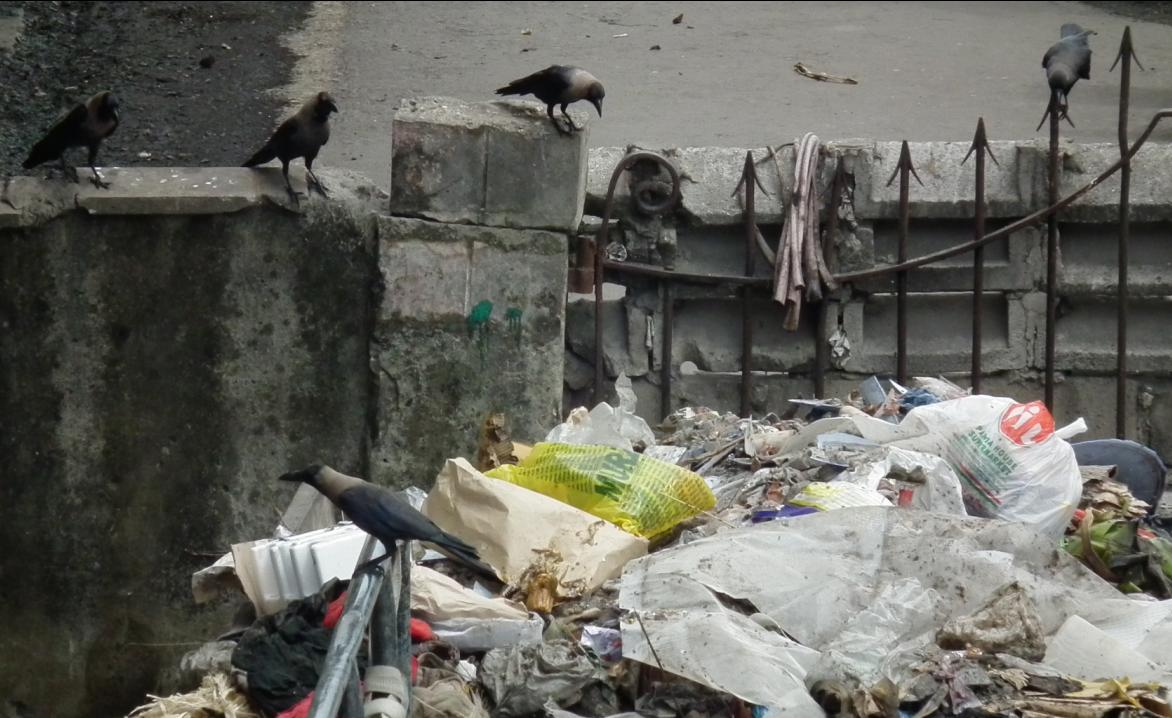
Landfall was sweet relief, and opting for the closest place, we made for the Bandari guest house - only three minutes walk from the harbour. Fun fact, Zanzibar has it's own immigration and you get another stamp in your passport for landing on the island; thankfully they didn't take the opportunity to charge you for another visa or something - although I'm surprised they don't. Bandari is a quaint little hostel, that much like all Zanzibar is a touch on the pricey side, with large rooms and complimentary breakfast. Luckily for us, they were willing to haggle the price down, but unluckily for us, across the road from our windows sat the local garbage container, full of trash and rotting fish, which always wafted in a nice smell when the breeze came from the ocean.
The shining gem of Bandari however was the TV for the guests to use, which was located just outside our room in the common area. Now I realize TV isn't much to get excited about, but aside from football in bars, I hadn't watched a thing since the first week of January. The three of us proceeded to sit in front of it well into the night, while watching such trash as top chef and wipe out. Brilliant programming!
The island itself is beautiful, and was a pleasure to explore. Zanzibar town is interesting, as it contains the widely known attraction of stone town which is then surrounded by a more sprawling and modern city. Stone town was a flashback to Lamu, with its close streets and maze like layout. It is missing the donkeys though, and instead has people on scooters and motorcycles zipping around the tight quarters.

Where Lamu has the advantage though, is with the street hawkers. The people trying to sell things near the ocean side in Zanzibar are so persistent and annoying that even if they had something you wanted you'd be inclined not to buy, just because they're too pushy. There is a fine line, and they all cross it. I had the same problem last night when I returned from safari and a guy I had never met was trying to get me to come to his hostel. If you spend six minutes pestering me after I just got out of a vehicle, gross from four days of tenting and dusty roads, I'm not going to cooperate with you, not a chance. And no, Zanzibar salesman, I don't need a scarf in forty degree weather, no it doesn't make it better if you give me three for ten, that just makes me warmer, no chasing me won't help. Know your target market!
Night time by the ocean is also very cool. In my last post I showed you pictures of the locals coming to jump into the waters at sunset. While this is going on, the local fisherman from the island congregate just down the coast and set up the nightly fish market. Every night all the fishermen set up grills and tables to cook up fresh all their catch from the day which they then sell to me, the tourist, at a marked up price. It is delicious. They have all sorts of skewers and chunks of who knows what sea creature, which they let you select and then take to the grill and cook in front of you. This was the first time I tried octopus, and it was actually pretty good.

From Zanzibar town we decided to head up the coast to the north of the island: Kendwa Beach. We decided to get there using public transportation, and with all our bags, climbed into the back of a dalladalla along with eighteen other people. The dalladallas are basically flatbed trucks with two rows of seats, open sides and a roof over top. Unfortunately for us it started to rain just minutes into our ride, and the powers that be lowered tarps down the sides, making the inside very dark and stuffy. I don't usually get motion sickness, but something about being in a closed space with the smell of eighteen locals and no air flow set my stomach off. Thankfully I didn't puke, and we managed to go about an hour and a half for 2000 shillings (roughly a $1.30). We later heard that people had taxied to Kendwa for as much as $40 American, suckers.
The main place to stay on the beach is a resort called Kendwa rocks, which fortunately also contains backpacker priced lodgings. This resort provided the building block for all the other resorts and the small town to crop up around. It was again fortunate for us that this happened, as food and drink was mind boggling pricey at our lodgings and we were able to wander just up the road for a more wallet friendly alternative. Aside from that, the resort contain a beautiful white sand beach, and the ocean was also a much nicer temperature than the soup near Zanzibar town.
After two nights we returned to ZT and decided to head back to Dar and move inland. The coast of Africa is beautiful, but it is over the top hot and the air is always about 100,000% humidity. Even if you're showering you're sweating, and life out from under the room fans is no fun. From Dar we decided to head to Arusha, the safari capital, and left early to the bus station to head out.
The ride from Dar to Arusha is a long one, and took us about ten hours all in. We arrived in the mid-evening and got off the bus tired and gross only to be assaulted by a horde of taxi drivers and safari totes. Much to their surprise, they couldn't understand why I was less than friendly while they were hounding me and pulling on me as I tried to get my bag out from under the coach. Jess, thankfully, had taken the time to map out where we would stay and it was a short walked from the station - we still managed to get no less than five cards from five people for the same safari company along the way though.
The next day we set out to find a well priced safari, and eventually made our way to no other than the place mentioned on the millions of cards we had been given the night before: meru treks. After surprisingly little debate, we had agreed to head out the very next day on a four day safari, which included Lake Manyara, Ngorongoro crater and Serengeti national parks.
We left early morning the next day and arrived out our campsite on a ridge overlooking lake Manyara just after noon. After dropping off the cook and the gear, we headed down towards the lake's national park, with cameras in hand and spirits high. The park by the lake was beautiful, and we managed to see all sorts of crazy African beasts, including many giraffes (possibly one of the strangest things going).

There was a spot by the lake where you could get out of the vehicle (at your own risk) and walk around near the hippo pond. It was a surreal field being on foot in an African park, as even though it seemed quiet enough, you couldn't help but wonder what was lurking around the next bush.

The next morning it was time to head into Ngorogoro crater, which in my opinion is one of the most beautiful places on this planet. The crater is a conservation area and not a park, and as a result the local Masai people are allowed to enter and graze cattle on the one side of the crater. As you can imagine, it was quite the site as you descended to see zebras, wildebeest and a man herding cattle all in the same field of view.

At the center of the crater was a giant lake, and as you descended, the mountains rolled up on all sides in breathtaking fashion, until all you could see was rolling plains spotted with large herds of animals and back dropped by green peaks.


We spent close to five hours in the crater, and in that time I managed to see the last one of the animals needed to complete the big five. The big five in Africa includes the leopard, lions, elephants, buffalo and the rarest of all rhinos. I was able to see all of those except the last during my safari in Uganda. Much to my pleasure then, at a fair distance, we had the luck to see two rhinos grazing!

Later in the day, as we were about to ascend from the crater and head to the nearby campsite, we made a quick stop at the only bathroom in the whole area. The bathroom is located in the only wooded area of the park, and featured black faced vervet monkeys jumping and playing as you walked into the facilities. As we were heading back to the land cruiser, our driver was looking very anxious and waved at us to "get in the car, quickly!". As we got in, he pointed down the road towards a lone bull elephant that was making its way up the lane towards us.
Turning on the vehicle, our driver took us over to the side of the clearing away from the elephant. The elephant instantly turned and again started walking towards us. Coming close, again our driver started the vehicle and tried to maneuver around the far side of the giant beast. That is when it charged! Hitting the gas and shifting like a madman, the vehicle just lurched out of the way as the giant animal came withing feet of charging the back end of the vehicle. We rocketed down the road in disbelief as the elephant gave a few meters of intense chase and with a trumpet of defeat, turned back. It was one of the most scary and awesome things I've ever seen.
That night we camped on a flat area located on the rim of the crater. The conservation area sprawled out underneath us as we had dinner and went to our tents to retire for the night. In the early morning was when I first could hear the hyenas. From what sounded like the edge of the campground, you could hear them communicating with each other in brief yelps. We're told they come for the leftover food, but I'm just glad they didn't decided to test the durability of the nylon tents.
The following day we headed to the Serengeti for the last two days of our safari. The Serengeti is also gorgeous, but in a much different way then the crater. The endless plains of grass seem to sweep off endlessly in all directions like a green ocean that you can't see the end of. Spotting the terrain is rocky outcroppings and lone Acacia trees that provide a change from the overwhelming vastness of the gigantic grasslands.
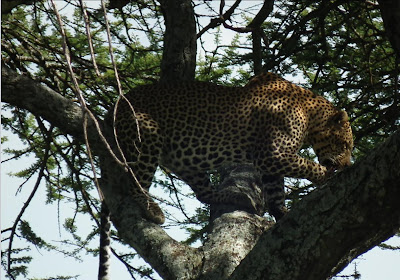
On our way towards our campsite we got very lucky. Seeing two land cruiser parked a ways away, our driver turned on his radio to find out what they were looking at. As we got closer, we got a very good look. Sitting in a tree, munching on something very much dead, was a leopard. Circling fifteen feet below him, waiting for the scraps, was a single hyena! Although the cars started rolling in after us, we had about ten minutes of really good viewing before the area was packed with cars and the leopard decided he was done. It is rare to just see them, let alone have them sit there eating in front of you! So cool.
One of the more inconspicuous animals on the Serengeti in terms of looks is the Cokes Hartebeest. However, with a name like that, I refused to believe that they were not being sponsored from the world power Coca-Cola. Therefore I decided to take the time to make this advertisement, and perhaps Coke will decide to reimburse me at a later date:

That night we stayed at a campsite located among a copse of trees. Much like the restroom station in Ngorongoro, the area was spotted with monkeys, and baboons coming in an out of the grounds was not uncommon. We even had the chance to see one of them turn on the facet and start drinking! However, I guess it had never heard of conserving water, because I was the one who had to walk over and turn off the water when he had finished. Just after night fall is when the lions first started calling out in the distance, and we went to bed with the sounds of the wild thick in the air.
Our last game drive was the following morning, and was no less amazing than any of the others. In the cool morning air, the sun was rising as we made our way around the park before breakfast. We managed to see another glimpse of a leopard, thousands of buffalo, packs of hyena and even a group of a hundred or so wildebeest running past - which we were informed was part of the great migration that is just beginning.
After breakfast we packed up and prepared to head back to Arusha. However, before we were free and clear of the park, we saw the one animal that I had wanted to see the most: cheetahs! As we were approaching the main gate out of the park, two male cheetahs were lazily strolling along the road, and did not seem at all concerned when we pulled up next to them. You can never take a bad cheetah photo, and I think I took too many. Such beautiful creatures, and definitely my favourite as a kid.

The rest of the trip was uneventful, and upon returning we were given free lodgings in maybe the nicest rooms I've stayed in in Africa. Unfortunately, apart from the free night, they were too pricey for our blood and we moved out this morning. Looks like Moshi is tomorrow, and with it a view of mount Kilimanjaro.
Sorry for the length,
Thanks for reading,
Sean

The night before we went to Zanzibar was spent trying to find an English pub in Dar Es Salaam. We had heard rumour through some means or another that this pub had the best fish and chips going; Arsenal also happened to be playing that night and we wanted to watch Premier football in an establishment that payed proper tribute to the leagues nationality. The only problem we faced was that we didn't know the name of the place. Small problem, right?
Somehow through vague hearsay from locals we got the notion in our head that the place was called the slip away Pub. Now the slip away itself in Dar is some fancy hotel on the harbour front, surrounded by a gaggle of choice stores; essentialy a strip mall on the waterfront. Knowing this, we were fairly confident that a pub could be hiding within the confines of the shopping area. That was the beginning of a very long and fruitless search, with everyone we asked pointing us in a different direction fifteen minutes walk away. With much frustration then, we finally ended up in a local place called the Q-bar, with the game thirty minutes old, and my want for a beer peaking.
The beer flowed. After the game (a disappointing draw from Arsenal) the sports bar miraculously shifted into a dance floor that had a live DJ and every song you've ever attempted at karaoke available for requests. No surprise then, we arrived back at our hostel late and rather intoxicated, and again no surprise that we walked to the port and boarded a two hour ferry journey in rather rough shape. It was the 'fast ferry' that we got on, but I still don't think it was quick enough for any of our likings. The Ferry, like every thing in Africa, would not be efficient if the management didn't take the opportunity to cram it full, well past the number of seats. Therefore, we spent the next two hour journey on the back deck by the engines, inhaling the fumes, feeling the pitch of the waves and keeping our eyes closed and breathing slow.
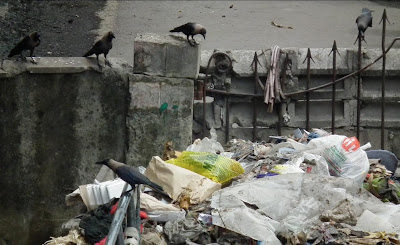
Landfall was sweet relief, and opting for the closest place, we made for the Bandari guest house - only three minutes walk from the harbour. Fun fact, Zanzibar has it's own immigration and you get another stamp in your passport for landing on the island; thankfully they didn't take the opportunity to charge you for another visa or something - although I'm surprised they don't. Bandari is a quaint little hostel, that much like all Zanzibar is a touch on the pricey side, with large rooms and complimentary breakfast. Luckily for us, they were willing to haggle the price down, but unluckily for us, across the road from our windows sat the local garbage container, full of trash and rotting fish, which always wafted in a nice smell when the breeze came from the ocean.
The shining gem of Bandari however was the TV for the guests to use, which was located just outside our room in the common area. Now I realize TV isn't much to get excited about, but aside from football in bars, I hadn't watched a thing since the first week of January. The three of us proceeded to sit in front of it well into the night, while watching such trash as top chef and wipe out. Brilliant programming!
The island itself is beautiful, and was a pleasure to explore. Zanzibar town is interesting, as it contains the widely known attraction of stone town which is then surrounded by a more sprawling and modern city. Stone town was a flashback to Lamu, with its close streets and maze like layout. It is missing the donkeys though, and instead has people on scooters and motorcycles zipping around the tight quarters.

Where Lamu has the advantage though, is with the street hawkers. The people trying to sell things near the ocean side in Zanzibar are so persistent and annoying that even if they had something you wanted you'd be inclined not to buy, just because they're too pushy. There is a fine line, and they all cross it. I had the same problem last night when I returned from safari and a guy I had never met was trying to get me to come to his hostel. If you spend six minutes pestering me after I just got out of a vehicle, gross from four days of tenting and dusty roads, I'm not going to cooperate with you, not a chance. And no, Zanzibar salesman, I don't need a scarf in forty degree weather, no it doesn't make it better if you give me three for ten, that just makes me warmer, no chasing me won't help. Know your target market!
Night time by the ocean is also very cool. In my last post I showed you pictures of the locals coming to jump into the waters at sunset. While this is going on, the local fisherman from the island congregate just down the coast and set up the nightly fish market. Every night all the fishermen set up grills and tables to cook up fresh all their catch from the day which they then sell to me, the tourist, at a marked up price. It is delicious. They have all sorts of skewers and chunks of who knows what sea creature, which they let you select and then take to the grill and cook in front of you. This was the first time I tried octopus, and it was actually pretty good.

From Zanzibar town we decided to head up the coast to the north of the island: Kendwa Beach. We decided to get there using public transportation, and with all our bags, climbed into the back of a dalladalla along with eighteen other people. The dalladallas are basically flatbed trucks with two rows of seats, open sides and a roof over top. Unfortunately for us it started to rain just minutes into our ride, and the powers that be lowered tarps down the sides, making the inside very dark and stuffy. I don't usually get motion sickness, but something about being in a closed space with the smell of eighteen locals and no air flow set my stomach off. Thankfully I didn't puke, and we managed to go about an hour and a half for 2000 shillings (roughly a $1.30). We later heard that people had taxied to Kendwa for as much as $40 American, suckers.
The main place to stay on the beach is a resort called Kendwa rocks, which fortunately also contains backpacker priced lodgings. This resort provided the building block for all the other resorts and the small town to crop up around. It was again fortunate for us that this happened, as food and drink was mind boggling pricey at our lodgings and we were able to wander just up the road for a more wallet friendly alternative. Aside from that, the resort contain a beautiful white sand beach, and the ocean was also a much nicer temperature than the soup near Zanzibar town.
After two nights we returned to ZT and decided to head back to Dar and move inland. The coast of Africa is beautiful, but it is over the top hot and the air is always about 100,000% humidity. Even if you're showering you're sweating, and life out from under the room fans is no fun. From Dar we decided to head to Arusha, the safari capital, and left early to the bus station to head out.
The ride from Dar to Arusha is a long one, and took us about ten hours all in. We arrived in the mid-evening and got off the bus tired and gross only to be assaulted by a horde of taxi drivers and safari totes. Much to their surprise, they couldn't understand why I was less than friendly while they were hounding me and pulling on me as I tried to get my bag out from under the coach. Jess, thankfully, had taken the time to map out where we would stay and it was a short walked from the station - we still managed to get no less than five cards from five people for the same safari company along the way though.
The next day we set out to find a well priced safari, and eventually made our way to no other than the place mentioned on the millions of cards we had been given the night before: meru treks. After surprisingly little debate, we had agreed to head out the very next day on a four day safari, which included Lake Manyara, Ngorongoro crater and Serengeti national parks.
We left early morning the next day and arrived out our campsite on a ridge overlooking lake Manyara just after noon. After dropping off the cook and the gear, we headed down towards the lake's national park, with cameras in hand and spirits high. The park by the lake was beautiful, and we managed to see all sorts of crazy African beasts, including many giraffes (possibly one of the strangest things going).

There was a spot by the lake where you could get out of the vehicle (at your own risk) and walk around near the hippo pond. It was a surreal field being on foot in an African park, as even though it seemed quiet enough, you couldn't help but wonder what was lurking around the next bush.

The next morning it was time to head into Ngorogoro crater, which in my opinion is one of the most beautiful places on this planet. The crater is a conservation area and not a park, and as a result the local Masai people are allowed to enter and graze cattle on the one side of the crater. As you can imagine, it was quite the site as you descended to see zebras, wildebeest and a man herding cattle all in the same field of view.

At the center of the crater was a giant lake, and as you descended, the mountains rolled up on all sides in breathtaking fashion, until all you could see was rolling plains spotted with large herds of animals and back dropped by green peaks.


We spent close to five hours in the crater, and in that time I managed to see the last one of the animals needed to complete the big five. The big five in Africa includes the leopard, lions, elephants, buffalo and the rarest of all rhinos. I was able to see all of those except the last during my safari in Uganda. Much to my pleasure then, at a fair distance, we had the luck to see two rhinos grazing!

Later in the day, as we were about to ascend from the crater and head to the nearby campsite, we made a quick stop at the only bathroom in the whole area. The bathroom is located in the only wooded area of the park, and featured black faced vervet monkeys jumping and playing as you walked into the facilities. As we were heading back to the land cruiser, our driver was looking very anxious and waved at us to "get in the car, quickly!". As we got in, he pointed down the road towards a lone bull elephant that was making its way up the lane towards us.
Turning on the vehicle, our driver took us over to the side of the clearing away from the elephant. The elephant instantly turned and again started walking towards us. Coming close, again our driver started the vehicle and tried to maneuver around the far side of the giant beast. That is when it charged! Hitting the gas and shifting like a madman, the vehicle just lurched out of the way as the giant animal came withing feet of charging the back end of the vehicle. We rocketed down the road in disbelief as the elephant gave a few meters of intense chase and with a trumpet of defeat, turned back. It was one of the most scary and awesome things I've ever seen.
That night we camped on a flat area located on the rim of the crater. The conservation area sprawled out underneath us as we had dinner and went to our tents to retire for the night. In the early morning was when I first could hear the hyenas. From what sounded like the edge of the campground, you could hear them communicating with each other in brief yelps. We're told they come for the leftover food, but I'm just glad they didn't decided to test the durability of the nylon tents.
The following day we headed to the Serengeti for the last two days of our safari. The Serengeti is also gorgeous, but in a much different way then the crater. The endless plains of grass seem to sweep off endlessly in all directions like a green ocean that you can't see the end of. Spotting the terrain is rocky outcroppings and lone Acacia trees that provide a change from the overwhelming vastness of the gigantic grasslands.
On our way towards our campsite we got very lucky. Seeing two land cruiser parked a ways away, our driver turned on his radio to find out what they were looking at. As we got closer, we got a very good look. Sitting in a tree, munching on something very much dead, was a leopard. Circling fifteen feet below him, waiting for the scraps, was a single hyena! Although the cars started rolling in after us, we had about ten minutes of really good viewing before the area was packed with cars and the leopard decided he was done. It is rare to just see them, let alone have them sit there eating in front of you! So cool.

One of the more inconspicuous animals on the Serengeti in terms of looks is the Cokes Hartebeest. However, with a name like that, I refused to believe that they were not being sponsored from the world power Coca-Cola. Therefore I decided to take the time to make this advertisement, and perhaps Coke will decide to reimburse me at a later date:

That night we stayed at a campsite located among a copse of trees. Much like the restroom station in Ngorongoro, the area was spotted with monkeys, and baboons coming in an out of the grounds was not uncommon. We even had the chance to see one of them turn on the facet and start drinking! However, I guess it had never heard of conserving water, because I was the one who had to walk over and turn off the water when he had finished. Just after night fall is when the lions first started calling out in the distance, and we went to bed with the sounds of the wild thick in the air.
Our last game drive was the following morning, and was no less amazing than any of the others. In the cool morning air, the sun was rising as we made our way around the park before breakfast. We managed to see another glimpse of a leopard, thousands of buffalo, packs of hyena and even a group of a hundred or so wildebeest running past - which we were informed was part of the great migration that is just beginning.
After breakfast we packed up and prepared to head back to Arusha. However, before we were free and clear of the park, we saw the one animal that I had wanted to see the most: cheetahs! As we were approaching the main gate out of the park, two male cheetahs were lazily strolling along the road, and did not seem at all concerned when we pulled up next to them. You can never take a bad cheetah photo, and I think I took too many. Such beautiful creatures, and definitely my favourite as a kid.

The rest of the trip was uneventful, and upon returning we were given free lodgings in maybe the nicest rooms I've stayed in in Africa. Unfortunately, apart from the free night, they were too pricey for our blood and we moved out this morning. Looks like Moshi is tomorrow, and with it a view of mount Kilimanjaro.
Sorry for the length,
Thanks for reading,
Sean
Friday, April 1, 2011
The Mysterious Disappearing Hostel

The remainder of our time in Nairobi was rather anticlimactic and dull. As the reputation of Nairobi told us *beware! danger!* much time was spent waiting inside a walled hostel compound for Brandon to arrive. Therefore, shortly after his landing in Kenya, Jess and I were eager to depart East towards the coast. Coinciding with our growing impatience, I had befriended two lovely German ladies (sisters, Lena and Judie) at the Nairobi hostel that were also headed in the same direction, and they provided added incentive to get a move on.
The night we grabbed the bus to Mombasa was cold and dreary. I'm generally opposed to night buses, especially after I got my fill of them in South America and double especially since the pace for this trip is fairly relaxed, and I'm not always saving my daylight for seeing things. Unfortunately for us, the cheapest tickets to Mombasa came with a night bus that left at 9 pm sharp (Ha! As if.) from the city center. Solemnly we rolled out of the city lights into the lightning splashed twilight of the rainy Kenyan countryside.
Now for most, I assume, night buses are probably a winning venture. Assuming you can sleep on a bus, you can get a night's rest, save a night's rent while traveling all at the same time. For me, however, I only manage to reap the last two of the benefits. Night buses bring me no sleep; time spent thinking instead, is how I fill the hours. Something about the pitch of a completely barren Kenyan wilderness can provoke deep thought in a person; compounded easily by a dreamlike waking state that results from the sleepless early morning hours.
Sitting there, watching dark shapes roll by the windows, wondering if it was a bush or elephant, I was lost in my head. Between futile attempts to sleep, I caught myself wondering on the purpose of travel. The back of a guide book I read in a hostel said: "We search, therefore we travel", but I'm left questioning the accuracy. What do travelers search for? It certainly can't be the short useless encounters with other travelers, or for photos of random landmarks, which are fleeting and meaningless - merely bragging rights against those left at home. Even worse, do we search for the longer friendships that travel can bring, which in the grand scheme hurt that much worse but last little longer? One theory is that we travel to see the difference. Traveling allows appreciation and understanding. One doesn't know what they have until they explore the alternatives. I'm still not sure, I'll keep looking into this one.
The bus arrived to Mombasa early the following morning. In total, I managed roughly thirty minutes of sleep during the whole ten hour ride, and even that near the end of the trip. In complete frustration I finally decided to lay myself down on the floor of the bus, which actually sort of worked, until shortly after the bus stopped to pick up a bunch of people looking to get a lift into the city. There went my extra seat and clean air. They were a particularly smelly group of individuals.
Once in Mombasa we immediately got hounded by a bunch of taxi drivers; after a little half-hearted and half-asleep haggling we agreed to pay way too much to be taken to a hostel called Mombasa backpackers. This place wasn't in the guide books, and we only knew of it because of the German girls we met were already there. The reason, we found out, was apparently because they had just switched to a location. Yet, this place didn't look or feel like a backpackers. The taxi after several minutes rolled out of town proper and out into the land of giant mansions with large fenced-in compounds.
At the gate, a masaii warrior in traditional garb let us in and we rolled up to the least hostel like hostel ever imagined. It honestly look like a million dollar mansion somewhere in the Hollywood hills. Also out of place were the proprietors of the place, a pair of (I think) gay lovers, one Peruvian and the other South African, who were nonchalantly smoking weed as we walked into reception (the living room?). For all intents and purposes it looked like two guys waited until the family of this house had left and then jumped the walls and started a hostel. Yet, rent was fair, the beds clean and the grounds had a pool - so we stayed.
Mombasa as a city is in my opinion, nothing special. We walked around the market district and found it to be much the same as all Africa - people will try and be your friend for your money. Along the coast, however, Mombasa is a pretty city. We walked by the old colonial fort (very expensive to enter) and through the old stone buildings of the coast. At one spot by the shoreline there was a rather picturesque scene of middle-eastern decent children jumping from a ten foot rock ledge into turquoise waters, while nearby the older men spent a lazy Sunday fishing the coast with a piece of line tied to their fingers. The breeze blew strong and fragrant off the Indian Ocean there, and for a long time I was content to just sit and exist.

From Mombasa, the five of us, as we had met with Judie and Lena, caught an early morning bus north along the coast to the island of Lamu. The bus ride was another seven hours, and the ferry out to the island thirty minutes on top of that - but the trip was definitely worth it. I'm not sure how widely known Lamu is outside of Kenya, but the word on the streets is that it is like Zanzibar, yet better as it doesn't get the traffic. I'm not sure how true this is, as there was a lot of tourists and have never been to Zanzibar (yet), but I deeply enjoyed my time there.

First of all, I'll start explaining Lamu by saying it is an island where many things are the same. Every man is the captain of a dhow boat, and for a 'fair' price, willing to take you snorkeling or diving or dolphin watching, or simply run you over to the next beach - it's the least they could do. Furthermore, everyone has a sister that does amazing works with henna tattoos, or a wife, but we were fairly certain that everyone's wife is another man's sister. Lastly, every man that doesn't own a dhow boat (which is very few), is instead a struggling artist that just wants to get by. They will have a backpack of their work on them and explain how they toil endlessly in their small houses to make their art, and again for a 'fair' price, are more than willing to offer me their services in creativity and shirt design.
In a less cynical tone, Lamu is indeed breathtaking. The old Islamic settlement hugs the coast closely, and features tall stone buildings and narrow street corridors. Indeed, the streets are so narrow that no motorized vehicles are allowed on the island (not exactly true) and instead the brunt of all transportation and labour falls to donkeys. In fact there are over four thousand of the beasts on the island, and one can hardly turn a corner without seeing two or three of them just standing and being.

The joke of Lamu is that you come for a day and stay for a month. Like most travelers, we laughed this off, and then fell right into the trap. I honestly think that part of the reason is that it is a pain in the ass to get there, and no one wants to hurry back to the dusty bus ride south. Moreover though, I think it is really just the intoxicating feeling of waking every morning with a view of the coast, and the taste of the salty air on your tongue. It truly is a beautiful island, and the real beauty in it is that it is small enough to be known to the hawkers after a short period - and they will leave you alone almost completely in a few days time.
We were obliged to do some of the touristy stuff, and over the week we were there we went on a dhow trip, snorkeled among the corals of the Indian Ocean, ate fresh fish on a boat near a long sandy beach and even ventured to hop on a donkey and go for a ride. I will say this in parting, the Ocean to some holds a magic of the soul, but almost subconsciously I always find myself wishing for freshwater when I swim in one.
~~~Interlude~~~
Sorry for the length of this blog, I am almost done. Let us finish:
After a drawn out and heartfelt goodbye, we finally summoned the courage and strength of will to leave Lamu. If you look at my last blog, you can take that as an indication of how little time I was really willing to waste while on that beautiful chunk of rock. From Lamu we set out to Malindi and there caught a matatu thirty minutes further south to Watamu, and ran into something we never expected: Italians.

It feels weird even to write this, but that specific section of the Kenyan coast exists in the orange hue of bronzer that exudes from the skin of Italians. Excessive hand gesturing and copious man thongs were indeed included. It was mind boggling to say the least. Little African children used to yell hello at me, and now enthusiastically sang Ciao in chorus. Stop it! Indeed, the presence of the Italians didn't just make the Muzungus annoying, but in turn the locals as well. As it was explained to me, Italians expect a a little banter, and as a result the salesmen got that much more aggressive and annoying. No dhows in Watamu, instead everyone has a glass bottom boat.
One neat thing we did do in Watamu was visit the turtle watch. The turtle watch is an organization that rescues injured turtles from the coast of Kenya and rehabilitates them back to health. On top of that, they monitor the local beaches for nesting sites and deter tourist vandalism as well as relocate nests that are in prone positions. By some stroke of fate and Brandon's mumbling of "we want to do things...", we ended up being put to work; cleaning the turtle tanks and doing a beach survey. We did however get to see two of the sick turtles, a green sea turtle and a hawksbill, which were both amazing. It is funny to say that the beach survey involved transects and other fun scientific methods, such that it felt like in a day in Watamu, I did more actual science than months in Uganda.

As we said goodbye to Watamu we also had to say goodbye to our German co-travelers, who by this point had been with us almost two weeks. This was a really hard parting, as I had spent a lot of time with them and became pretty close. Much like when Chris and Richard left us, we had to part with good friends unknowing of when we'd see them next. Bye Judie and Lena, I hope to see you soon.
From Watamu we went back to Mombasa, and immediately booked tickets south to Dar Es Salaam and Tanzania. From the bus station we hopped into a tuk tuk and headed back to Mombasa backpackers, which had proved a worthy enough hostel the time before. The tuk tuk brought us back to the gate of the compound and we paid him and sent him along before pushing open the heavy gate.
Immediately we noticed that the ever present door guard in masaii dress was missing from the little hut next to the gate - along with his craft table. Odd. As we moved further in we noticed more absences - such as furniture. Where was the patio furniture, the outside bar fridge and bar stools? Lastly, where were the people? The ever presents: the owners and the slow to leave travelers? Then the people came, out walked a Kenyan family: husband, wife and baby, and proceeded to stare at us with surprise and disdain. Who were these three uncouth travelers with large backpacks and the nerve to simply walk into their gated haven.
Where the hell did the hostel go? We sat outside the gate for the next thirty minutes trying to decide whether we had dreamed the whole place up in the first place. Then we started going over every fishy thing that had ever occurred there, like how when I asked if they were going to build a sign for their hostel, the owners immediate response was "probably not". Were they even real?
After much running around we finally managed to get rooms at dive called the Tana guest house. Although the staff was a little strange and the digs a bit shabby, when I woke up at 6am I could see my bus parked across the street, and that is pretty awesome.
I now write to you from Dar Es Salaam, Tanzania, and I don't know how to feel about it. Kampala was ugly, but endearing thanks to its energy and people. Nairobi was ominous and threatening, yet beautiful and metropolitan. Dar seems to have neither of these, it lacks the hustle and bustle to compete with Kampala, and is void of the pretty green space that begrudgingly made me kind of like Nairobi. I will remain for the time being, undecided.
Thanks for reading,
Much Love,
Sean

Tuesday, March 15, 2011
Kenya Dig it? Nairobi vs Kampala, and other news.

As you may have guessed, the time for Kenya has arrived. However, unlike the way we did Uganda, we're starting in the city first. Sunday morning, awoken at 5:30 by the call to prayer of Kampala's ever-too-close-to-our-hostel mosque, we packed and set out to catch the bus for our first long overland bus trip of Africa.
Setting out for Nairobi at just after seven in the morning, we rolled in roughly thirteen hours later just as the dark was settling. This may just be a pet peeve of mine while traveling, but I really detest entering into a new city after dark. But unfortunately, like Kasese, Jinja and Kampala before it, Nairobi became another city of twilight. There are many reasons for this dislike, but the main one is that I have a very hard time getting a proper feel for a city when the sun goes down. Everything in what could be an otherwise friendly place seems to gain a sinister quality that is just off putting.
Thoughts on Nairobi: It becomes apparently very quickly that Kenya is a country of considerably more wealth than its East African neighbors. The city center is clean and beautiful, with many green filled parks and looming skyscrapers. Prices for things are also a lot more expensive. At times walking through the downtown I felt as if I could have been in a part of Toronto on a summer's day.
The bad thing about Nairobi, sadly, is that reputation proceeds it. Outside the core of the city exists slums and poverty. The sinister quality of Nairobi after dark is more than just a trick of the mind in a lightless world. Crime is common, muggings frequent and vigilance required. It is unfortunate that a city with so much potential beauty is at the mercy of the economic divide that exists all over Africa. The ultimate result though, is that Nairobi gets the reputation of being boring. Taxis are expensive and the night life is dangerous; tourists can't be bothered or hesitate to really take in the city, and end up sitting in a hostel waiting for bed. Shame.
In stark contrast to Nairobi, is the vibrant nightlife of Uganda's capital: Kampala. Kampala is bonkers. My first look at Kampala was on a pass through on our way to Jinja from Fort Portal. Catching a late morning link bus from Fort Portal, we arrived in Kampala just around early evening, and set out on foot from the bus terminal to the taxi park to grab a matatu to Jinja.
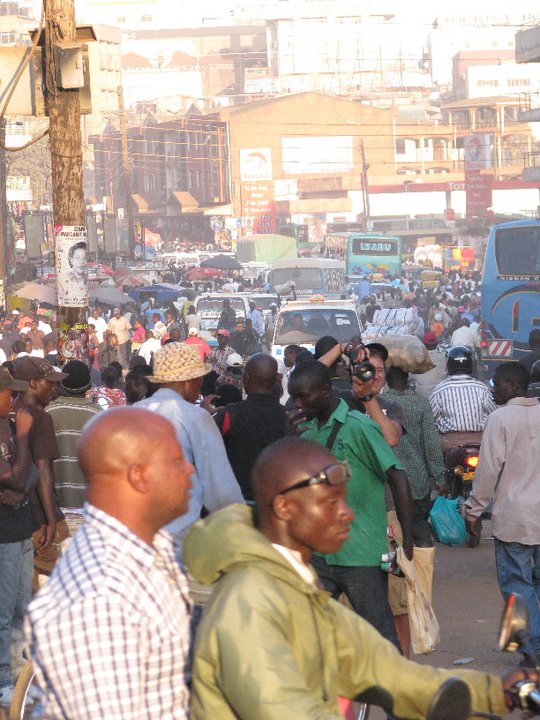
Picture Kampala and its taxi park like this: You're walking in the woods and you hear the distinctive sound of a hornet's nest. Grabbing the hornets nest, you lay it on the ground and look around for a big stick. Upon finding that stick, you smash the hive repeatedly and watch the wasps swarm about you. Now instead of wasps, picture yourself on a dusty city block and people are swirling about you in like fashion. Most are in a hurry, some are trying to sell you crap and others just look lost and mill about. It is bonkers! There are literally hundreds of taxis, honking and strewn about the lot. Vehicles move by continually, opening and closing gaps in all directions; as you try to walk the world around you is turned into a shifting labyrinth of noise, metal and exhaust. The only thing more intense then walking through it is attempting to boda the streets during rush hour. Holy crap!

Link to a photo of the Taxi Park

Kampala proper is no less amazing. Take all the aspects of rural Uganda and drop them on a more built up metropolitan background and then magnify it 100 fold and you'll find yourself in Kampala. Markets spring up on all side streets, vendors spread cloths with their wears on the side of busy avenues and noisy children ask for your money. Yet, simultaneously behind it, fast food restaurants and fancy hotels exist, patronized by portly city dwellers; showing the first signs of people living in excess that I've seen in all my time in Africa.
At night the bars and clubs of Kampala light up, and keep going until late the following morning. In our escapades, Richard, Jess and I found ourselves at a small bar on a side street of Old Kampala that was actually featuring the rarity of live music. Already fairly intoxicated, we stormed the dance floor to find it deserted among a sea of seated watchers. Unhindered by the inhibitions of our sober audience, we tore it up, many times challenging the people in chairs to join us. Within a short time, obviously jealous of our fun, we managed to get the whole bar on the floor. Such was our enthusiasm that about an hour later as the band winded down its set, a round lady who had been working the bar came about the floor and pressed into our hands a coin. You heard me, I got paid to dance. A whole 100 shillings. I figure that to be about 4¢. Kampala is pretty awesome.
Aside from that, the only other big thing we've done in the past couple weeks has been our white water rafting of the Blue Nile in Jinja. Unfortunately the cafes in Nairobi don't seem to let me put up pictures, but anyone with Facebook access to Jessica or myself will see that there are a couple pictures up (mom and dad, ask Kase to show you!). The day that we went was beautiful, and the stretch of river was between 30 and 40 km. And, even though over that stretch there was only about ten rapids, the water was so warm and nice that during the calm periods we'd lay about in the river and take turns flipping into the water off the raft.
Not much is new besides that. We spent a little bit of time at the crater lakes near Fort Portal that were crawling with monkeys. That was pretty neat, as when you were eating or walking back to your room, colobus monkeys would be within arms reach, playing, fighting and making noise.

Currently we must sit in Nairobi for a couple days yet. Our English friends that we've been with for the past two and a bit months are flying out tomorrow for the north of Africa, and Brandon comes into Nairobi on Thursday. From here all signs point to Mombasa or Lamu which both lie out towards the coast of the Indian Ocean. Our time in Kenya will probably be only a few weeks, and then we'll head south to Tanzania!
Thanks for reading,
Sean
Saturday, February 19, 2011
that's the boy... that's the kid...

I'll start this post with a long overdue acknowledgment. Hello, good day and how are you to every single person that works behind the front doors of Jones Feed Mills. Yes Lori, I do check comments!
I apologize for not sending any individually addressed emails - but it's not my fault! You see, I realized soon after I started this trip that I had relied a little too heavily on the address book Dave has compitently compiled into Outlook - and thus never really took the time to learn all of them. I'm pretty confident that they are all as basic as name@jfm, but I didn't feel like taking the time to guess a hundred combinations and play the odds that most people were hit. I know you guys talk, and I know feelings would be hurt if names were missed. No tears shall be spilt on my account.
This said, I would like to reiterate again how much I enjoyed working with all of you - and for the life of me can not comprehend how that place operates in my absence. It was because of the wonderful time spent with all of you that I am able to fund my time abroad. For those of you who read this, please take a page out of Lori's book and drop a comment, along with your email and I will send you something more personal. Anyone can comment - even you.

Shout out aside, I had a epiphany last week - want to hear it? To set the scene, I should explain that I have developed a new haunt in Kisoro. A couple weeks back a new cafe opened just around the corner from the Golden Monkey hostel, right next to the craft shop run by the German lady, Val (I think I've mentioned her in a previous post). Unsuprisingly, the cafe is run by the same woman, and operates in an organized and exact way that is alien to these parts. Furthermore, the lady who operates as the waitress is an expat of Canada and pretty much awesome to talk with - amazingly friendly and cheery.
For all these reasons, and the fact that you can get food in less than two hours, this restaurant provides a little bubble of normalcy in the otherwise foreign and chaotic atmosphere of East Africa. It was while I was there last Thursday morning, drinking filtered coffee (instead of tinned!) and being stared at like a fish in a bowl by passerbys (really driving home the bubble feel) that I realized that I like it here. I like Africa.
This may not seem like much of an epiphany, so I will explain. Over my first month here, there has always been this itch in the back of my mind that something wasn't quite right - something I couldn't put my finger on. Although it didn't really impede my ability to function, it did provide me with some reservation and even hestiation that I would define as uncharacteristic. It left me feeling at odds with the continent.
Yet, for some reason, having this place that was almost a teleporter to a different world, allowed perspective. I realized that I like the organized chaos, the loosely based time schedule and the muzungu status that dogs a traveler like me through Africa. The only thing that I am unable to place is whether the creation of an escape gave me the chance to truly value what I had, or the allowance of a respite emboldened me to truly embrace the culture knowing that I had a temporary out close at hand to use.
Regardless of the answer, the shift in attitude could not have come at a better time. With the start of some true backpacking about to begin, a slightly cocky swagger to the ways of Africa is a blessing. It does, however, mean that I am about to throw away all the stability and routine that I have managed to build. I will honestly say that I am quite excited to become a little more transitory. Classic backpacking holds such a romantic notion with me, that I am elated to truly hit the dusty, broken roads of Africa for the first time.

Who is Pudge you ask? Pudge is my sister
She tends to be annoying, much like a blister
But I wouldn´t trade her for the world
Pudge is a bit chunky, thick at the thighs
¨Don´t call me Pudge!¨ she idly cries
But I wouldn´t trade her for the world
When she moves she jiggles
And if you poke her she giggles
But I wouldn´t trade her for the world
However, maybe for a robot.
Jessica looks excited too!She tends to be annoying, much like a blister
But I wouldn´t trade her for the world
Pudge is a bit chunky, thick at the thighs
¨Don´t call me Pudge!¨ she idly cries
But I wouldn´t trade her for the world
When she moves she jiggles
And if you poke her she giggles
But I wouldn´t trade her for the world
However, maybe for a robot.
It conincides with these sentiments that I had recently just started - and finished - reading the book, The Beach. I'm not sure why I had never read it before, but I can reckon that it was probably because I remember seeing the movie back when and finding myself less than inspired. That, however, was a different time, and the nuances and romance of the life of the traveler was lost on me. This go through though, it struck chords. The narration is first person, and done in a simple yet elegant way that niether demands nor insults. Reading The Beach is more like thinking through your own thoughts than taking the words off the paper. It touches and bounces on so many thoughts and sentiments that I can relate to - allowing it to add itself neatly to the list of my favourite books. The only bad thing about it is that it has me mumbling the words "that's the boy, that's the kid..." quietly to myself. Although I don't feel like writing any more of a book review, it has got me thinking, and I can appreciate anything that does that.
Lastly in the news department is the wildlife. I had made a joke to Jess about half a month ago that the forest, and its animals, operated much like a video game. The premise of the game is that seeing animals beats levels; every animal is a boss. This joke was timed after a stint in the woods where we had seen so little fauna for it to be laughable. The driving comment I made was that as soon as we saw Gorillas, the last boss, we'd unlock all content.
Not suprisingly then, in the last week and a bit since we trekked the jungle of Bwindi, some fun stuff has happened! Last week, first thing in the morning, Jess and I were making a usual walk to the monkeys, and were not at all suprised to see the regular signs of buffalo and elephants in the mud. We made our often ignored half joke / half pleas to follow the tracks, and again were not at all suprised to hear them rejected. Therefore, the suprise came not ten minutes later when we discovered that something had decided to stick around! We were close to entering the forest proper when we were stopped, and directed with pointing fingers to look to the other side of a dried up stream bed. Standing, large as life, just thirty feet away, was a full grown male forest elephant. It didn't stay too long, but I did manage a nice photo of it's butt. Joking aside, hell yes elephant!

Add on to that the fact I saw a bush buck today on the way to see the habituated golden monkey group, and you might think that the forest did in fact have some organized viewing sequence to it. I can just imagine the UWA walking ahead of me and kidnapping all the animals until I shelled out money for a Gorilla permit. What a sneaky and devious ploy.
The habituated group of golden monkeys was neat, but rather anti-climactic. It is hard to get really, really worked up to see something that I have been viewing for the past month and a half. It was neat to see them so close though, and more importantly frustrating that in the first ten minutes I had collected many more, and better photos than a month plus of efforts had produced.

Tonight is a goodbye party night, and will most likely be one big wreck. We all went to the marketed on Thursday and managed to assemble the ugliest ensembles we could find. The tour de force of my paticular number is a stunning black cardigan featuring Winnie the Pooh and Tigger holding hands. Best friends is neatly embroidered across the chest. I worry for the person who actually bought this from disney, but reckon it was perhaps that gift you might recieve from a strange and distant relative.
No other news to report, must go be ridiculous.
Thanks for reading,
Sean
Saturday, February 12, 2011
Gorillas!
Since the turn of the century, modern technology has been steadily introduced into east Africa. Bank machines, cell phones, internet and even something as seemingly basic as electric power can all be listed among the advances still relatively new to certain regions of the continent. As an outsider visiting Africa for the first time, you may do as me and take all these conveniences for granted while visiting - but ask any kid or adult over the age of ten and more than likely they can tell you a tale of being without some or all of the things listed above.
Since the technology is relatively new, the assimilation of it into the every day life would be assumed slow. Furthermore the implications one draws from new technology built on an old, unreliable infrastructure is obviously apparent. You'd expect things not to work. They don't, not always, not well. Therefore the true surprise is how dependent they really have become on it. When power is out the people curse; parents would rather put money on their phones than eat and sit around listlessly when the network is down. But, in this travelers opinion, the most annoying, nay most frustrating thing about all the new technology is that nobody knows how to use it.
An example? Ask any of my traveling cohorts and they will be quick to back me up if I said lines at the bank were often long. At first we had many theories - the bank is out of money, the power is out, the machine is broken, the client base is too big - until we had to overshoot our destination of Bwindi two weeks ago, to drive another hour to Kabale and money.
Our trip to Bwindi on that faithful day, unfortunately, was not to see the Gorillas, but instead to visit a man named Edward who was researching them. Nice man, nice place, fun party. Anyways, there was a group of us and we needed a private car, which normally isn't an issue. However, during that particular week there had been a line in front of the Kisoro bank for hours every day, and we had been unable to withdraw money. The driver probably wasn't going to take us for free, regardless of how seductive Richard, Chris and I acted. Hatching a plan, the decision was made to overshoot our destination to Kabale, which has six banks, and in our minds no such problems.
As we rolled into Kabale, a dusty shanty town of a tourist hub, we were obviously fairly surprised to find that every bank had a line of at least ten people. However, the lines appeared to be moving (slowly), and we had no alternative options, so we waited semi-patiently. After about thirty minutes in line we finally got to the ATM. Thirty seconds later we were all left scratching our heads. Why had every other person taken five to ten minutes?! That is right, folks, they just don't know how to use the damn machines. Days of waiting and a two hour return trip to Kabale to find out that all our issues with money were because everyone wanted to use the technology and didn't know how - instead, putting in their cards and mashing buttons with wadded fists while a thin line of drool runs down their cheek until it spits out money.
Layer on top of this multiple incidents where the power has been out for the majority of the day, a week of no phone service, and an annoying man who asked me to set him up a website (with a picture) for his business and unquestionably we've had our struggles with the 'modern conveniences'.
I can hear you asking questions. I hear it. The question you keep asking me is "what the hell does this have to do with Gorillas? Get to the Gorillas." OK, I will get to them now - but you'll be grateful for this background.
I will indicate with a little denotation where we got lucky with technology.
You see, our expedition to the Gorillas started out rather serendipitous. As we were settling down for bed at the park on Thursday night, Jess and I were disturbed by a flurry of activity at the door. Darja and Wippollo were at our door, both with phones to their ears - one talking to Molly and one to Loy, who are employees at the Golden monkey hostel - and had news of Gorilla permits on the cheap! They also agreed to arrange for us Boda pickup very early from the park and a private car to take us to Bwindi, this time to see the Gorillas!
-> Lucky the phones were working
At five on the dot, the bodas roared up the hill to find us waiting eagerly. The ride down was relatively smooth, although we were caught in the catch-22 of night time boda driving. You see, the roads are terrible, and as a result, and especially at night, the drivers like to go slow and have lots of light. The problem of course is that the lights are directly connected to the throttle. This means you need to gun it to see and consequently hit the bumps, or go slow and careful in the pitch dark. I was oddly amused by this.
-> Good thing the Boda Boda drivers decided to be reliable
We arrived in Kisoro at ten to six and had the drivers drop as off at Stanbic bank. We were pleased to see that the lights were on, and the line non-existant. It is funny to observe us when we approach a bank in day light hours, because every local person gets in a mad rush to beat the Muzungu to the machine. They are right to do so. At just before six on a Friday morning, Jess and I managed to take just under two million shillings out of the bank. Although to us this is only several hundred dollars, it goes a lot further in Africa. I can only imagine the frustration Friday morning when people started lining up to try and use their bank cards only to find it pretty sparse on cash.
-> Power was on, bank had money, there was no line!
We arrived at the hostel just as the car was pulling in, and in no time at all were off and on our way to Bwindi and Gorillas! The ride itself took about two hours, and included a brief stop for us to actually pick up our permits. As I may not have explained, we had our names down on a list for cancellation permits. Basically a cancellation permit is a permit that is sold kind of second hand (and illegally) by a tour company when someone who has booked the Gorilla trekking through them calls off their visit. The benefits are that I only had to pay $300 for a regular $500 permit, and that money goes right into the pocket of the company. Win, win!

So at about 6:30, with the sun rising, we stopped at a crossroads in what can only be described as the middle of nowhere. After about a three minute wait, a boda pulled up beside our car and a man jumped off holding two permits. After a little negotiation and a million plus shilling transaction, Jess and I were left holding two permits made out for Americans: mine saying Alan and the other Ilona with a last name indecipherable.
Fast forward about thirty minutes to find us in line behind two french girls at the debriefing banda for Gorilla trekking, waiting to register. In one hand we had our permits with our American identities and in the other we had our passports with the names our parents chose; all we could do was stare at each other and then at our documents. When we finally reached the table, he looked at the documents briefly, comparing, then quickly glanced at us and kept on writing without saying a word. You did it Alan, you got to see your Gorillas after all!
Things really had worked out perfectly. All these tiny variables that could have gone wrong and had us up the night before in a pessimistic fret worked to a tee. We were at the park, with valid permits in hand, lined up to be the only two actually going out to see our selected group. Everything was perfect!
Que reality. To the rhythmic sound of shuffling feet, in entered the all German 70+ Bridge Club / mall walker society (I called them both interchangeably) in a whirl of beige and khaki. Button up shirts, trousers hiked to the chest and pant legs tucked neatly into the socks, arriving to set the pace for the whole trek. I must say that I am at least a little proud of them in the way they managed to turn a potentially compact five-hour trek into a nine hour mission.

Let me begin by saying that the park gets its name Bwindi Impenetrable Forest for a reason: this was not an easy hike. At it's easiest parts, you were walking through dense foliage on the edge of a pretty large drop. The angle of the path was severe and tested the strength of your ankles as it went over slippery rocks and slick grass. At first the continuous falling of the ladies was sadly humorous, but as the minutes turned to hours, it became much more frustrating.
The whole group of women was so beat up and tired, that after we made it to the apes, half of them just kind of wilted onto the vegetation and handed their camera limply to the trackers, not even bothering to take the time to view for themselves. I was fairly annoyed with them come that point, because I couldn't for the life of me figure out why they had come. Please know your limits, readers of this blog, the Gorilla trek in Bwindi is exactly that, a trek. It is not a catered safari in the back of a land cruiser - it is one hell of a walk. It is a lot of up and down hills, through very thick vegetation at an elevation of 2000 m above sea level (hence mountain Gorillas). I don't want to sound like a bigot, or an impatient ruffian but I couldn't help but feel like it was just very inconsiderate to us and the guides/porters who literally at times had to push and pull them up the hills. End Rant.
The gorillas themselves were amazing. It was simply astonishing how after the longest three hour hike of my life, how short the hour with the animals felt. We heard the animals before we could see them, and were greeted on arrival with the sounds of breaking branches and the trampling of foliage. After another minute of walking through grass, we came out into a semi-clearing where a baby gorilla was sitting alone, very cutely, eating the shoots of a plant. That was the start of the magic.
From that point on it was non-stop Gorilla action for the next hour. We saw everything! There were gorillas climbing trees, females punching the trackers and Jess even managed to get on camera a fight between the dominate silver back and a lesser one. While those two were fighting, the third silver back, who was only about 2 feet away from me was getting very agitated and making all sorts of aggressive calls and growls. "Stand still, keeping taking pictures, don't run, you're fine" was what the tracker kept repeating to us, as Jess and I (the old women had passed out somewhere further away) were encased by a triangle of three silver backs in the midst of a fight. While the males were fighting, the females and the baby were up in a tree eating fruit and then throwing them at us. So, so, so cool!


The walk back was very similar to the walk there, except without the excitement of Gorillas for motivation. Rest stops would usually include Jess and I tapping our feet for twenty minutes with the lead tracker as we waited for the rest to catch up. By this time in the day, I was pretty much dying. Since the planning had been done at 10:00 pm the night before, we had not been able to get any food, water or sleep. Therefore during the hike back I had yet to eat, had long run out of the little water I brought and was exhausted from the trekking - all the while having to wait for the ladies to catch up.
Eventually we managed to convince one tracker to take us back without the group, and I think it saved us about two hours. The hardest part of the trek is a big hill at the very end, and I'm glad I didn't have to be there for them climbing it. After finally dragging our half-dead selves to the top of the hill, and fighting off the many types of merchandise thrown at us (every t-shirt is the same gross green) we were finally back in the car and on our way to Kisoro.
After dinner and some much deserved beer we caught the pickup truck back to Mgahinga, where we promptly fell asleep and finished off one of the longest, if not coolest days ever. We walked back into Kisoro today, and after finding some liquids, basically threw ourselves into the first internet place we found. The power keeps flickering, and it's really warm, but I'm enjoying the rest.
Other than that, the only real news is that Jess and I have been teaching science at the local primary school. I've been teaching grade 6 and the classification of animals, while Jess does 5th grade and is teaching about poultry and keeping birds. I'm basically Bill Nye, you should call me that.
Thanks for reading,
Sean
Since the technology is relatively new, the assimilation of it into the every day life would be assumed slow. Furthermore the implications one draws from new technology built on an old, unreliable infrastructure is obviously apparent. You'd expect things not to work. They don't, not always, not well. Therefore the true surprise is how dependent they really have become on it. When power is out the people curse; parents would rather put money on their phones than eat and sit around listlessly when the network is down. But, in this travelers opinion, the most annoying, nay most frustrating thing about all the new technology is that nobody knows how to use it.
An example? Ask any of my traveling cohorts and they will be quick to back me up if I said lines at the bank were often long. At first we had many theories - the bank is out of money, the power is out, the machine is broken, the client base is too big - until we had to overshoot our destination of Bwindi two weeks ago, to drive another hour to Kabale and money.
Our trip to Bwindi on that faithful day, unfortunately, was not to see the Gorillas, but instead to visit a man named Edward who was researching them. Nice man, nice place, fun party. Anyways, there was a group of us and we needed a private car, which normally isn't an issue. However, during that particular week there had been a line in front of the Kisoro bank for hours every day, and we had been unable to withdraw money. The driver probably wasn't going to take us for free, regardless of how seductive Richard, Chris and I acted. Hatching a plan, the decision was made to overshoot our destination to Kabale, which has six banks, and in our minds no such problems.
As we rolled into Kabale, a dusty shanty town of a tourist hub, we were obviously fairly surprised to find that every bank had a line of at least ten people. However, the lines appeared to be moving (slowly), and we had no alternative options, so we waited semi-patiently. After about thirty minutes in line we finally got to the ATM. Thirty seconds later we were all left scratching our heads. Why had every other person taken five to ten minutes?! That is right, folks, they just don't know how to use the damn machines. Days of waiting and a two hour return trip to Kabale to find out that all our issues with money were because everyone wanted to use the technology and didn't know how - instead, putting in their cards and mashing buttons with wadded fists while a thin line of drool runs down their cheek until it spits out money.
Layer on top of this multiple incidents where the power has been out for the majority of the day, a week of no phone service, and an annoying man who asked me to set him up a website (with a picture) for his business and unquestionably we've had our struggles with the 'modern conveniences'.
I can hear you asking questions. I hear it. The question you keep asking me is "what the hell does this have to do with Gorillas? Get to the Gorillas." OK, I will get to them now - but you'll be grateful for this background.
I will indicate with a little denotation where we got lucky with technology.
You see, our expedition to the Gorillas started out rather serendipitous. As we were settling down for bed at the park on Thursday night, Jess and I were disturbed by a flurry of activity at the door. Darja and Wippollo were at our door, both with phones to their ears - one talking to Molly and one to Loy, who are employees at the Golden monkey hostel - and had news of Gorilla permits on the cheap! They also agreed to arrange for us Boda pickup very early from the park and a private car to take us to Bwindi, this time to see the Gorillas!
-> Lucky the phones were working
At five on the dot, the bodas roared up the hill to find us waiting eagerly. The ride down was relatively smooth, although we were caught in the catch-22 of night time boda driving. You see, the roads are terrible, and as a result, and especially at night, the drivers like to go slow and have lots of light. The problem of course is that the lights are directly connected to the throttle. This means you need to gun it to see and consequently hit the bumps, or go slow and careful in the pitch dark. I was oddly amused by this.
-> Good thing the Boda Boda drivers decided to be reliable
We arrived in Kisoro at ten to six and had the drivers drop as off at Stanbic bank. We were pleased to see that the lights were on, and the line non-existant. It is funny to observe us when we approach a bank in day light hours, because every local person gets in a mad rush to beat the Muzungu to the machine. They are right to do so. At just before six on a Friday morning, Jess and I managed to take just under two million shillings out of the bank. Although to us this is only several hundred dollars, it goes a lot further in Africa. I can only imagine the frustration Friday morning when people started lining up to try and use their bank cards only to find it pretty sparse on cash.
-> Power was on, bank had money, there was no line!
We arrived at the hostel just as the car was pulling in, and in no time at all were off and on our way to Bwindi and Gorillas! The ride itself took about two hours, and included a brief stop for us to actually pick up our permits. As I may not have explained, we had our names down on a list for cancellation permits. Basically a cancellation permit is a permit that is sold kind of second hand (and illegally) by a tour company when someone who has booked the Gorilla trekking through them calls off their visit. The benefits are that I only had to pay $300 for a regular $500 permit, and that money goes right into the pocket of the company. Win, win!

Fast forward about thirty minutes to find us in line behind two french girls at the debriefing banda for Gorilla trekking, waiting to register. In one hand we had our permits with our American identities and in the other we had our passports with the names our parents chose; all we could do was stare at each other and then at our documents. When we finally reached the table, he looked at the documents briefly, comparing, then quickly glanced at us and kept on writing without saying a word. You did it Alan, you got to see your Gorillas after all!
Things really had worked out perfectly. All these tiny variables that could have gone wrong and had us up the night before in a pessimistic fret worked to a tee. We were at the park, with valid permits in hand, lined up to be the only two actually going out to see our selected group. Everything was perfect!
Que reality. To the rhythmic sound of shuffling feet, in entered the all German 70+ Bridge Club / mall walker society (I called them both interchangeably) in a whirl of beige and khaki. Button up shirts, trousers hiked to the chest and pant legs tucked neatly into the socks, arriving to set the pace for the whole trek. I must say that I am at least a little proud of them in the way they managed to turn a potentially compact five-hour trek into a nine hour mission.

Let me begin by saying that the park gets its name Bwindi Impenetrable Forest for a reason: this was not an easy hike. At it's easiest parts, you were walking through dense foliage on the edge of a pretty large drop. The angle of the path was severe and tested the strength of your ankles as it went over slippery rocks and slick grass. At first the continuous falling of the ladies was sadly humorous, but as the minutes turned to hours, it became much more frustrating.
The whole group of women was so beat up and tired, that after we made it to the apes, half of them just kind of wilted onto the vegetation and handed their camera limply to the trackers, not even bothering to take the time to view for themselves. I was fairly annoyed with them come that point, because I couldn't for the life of me figure out why they had come. Please know your limits, readers of this blog, the Gorilla trek in Bwindi is exactly that, a trek. It is not a catered safari in the back of a land cruiser - it is one hell of a walk. It is a lot of up and down hills, through very thick vegetation at an elevation of 2000 m above sea level (hence mountain Gorillas). I don't want to sound like a bigot, or an impatient ruffian but I couldn't help but feel like it was just very inconsiderate to us and the guides/porters who literally at times had to push and pull them up the hills. End Rant.
The gorillas themselves were amazing. It was simply astonishing how after the longest three hour hike of my life, how short the hour with the animals felt. We heard the animals before we could see them, and were greeted on arrival with the sounds of breaking branches and the trampling of foliage. After another minute of walking through grass, we came out into a semi-clearing where a baby gorilla was sitting alone, very cutely, eating the shoots of a plant. That was the start of the magic.
From that point on it was non-stop Gorilla action for the next hour. We saw everything! There were gorillas climbing trees, females punching the trackers and Jess even managed to get on camera a fight between the dominate silver back and a lesser one. While those two were fighting, the third silver back, who was only about 2 feet away from me was getting very agitated and making all sorts of aggressive calls and growls. "Stand still, keeping taking pictures, don't run, you're fine" was what the tracker kept repeating to us, as Jess and I (the old women had passed out somewhere further away) were encased by a triangle of three silver backs in the midst of a fight. While the males were fighting, the females and the baby were up in a tree eating fruit and then throwing them at us. So, so, so cool!


The walk back was very similar to the walk there, except without the excitement of Gorillas for motivation. Rest stops would usually include Jess and I tapping our feet for twenty minutes with the lead tracker as we waited for the rest to catch up. By this time in the day, I was pretty much dying. Since the planning had been done at 10:00 pm the night before, we had not been able to get any food, water or sleep. Therefore during the hike back I had yet to eat, had long run out of the little water I brought and was exhausted from the trekking - all the while having to wait for the ladies to catch up.
Eventually we managed to convince one tracker to take us back without the group, and I think it saved us about two hours. The hardest part of the trek is a big hill at the very end, and I'm glad I didn't have to be there for them climbing it. After finally dragging our half-dead selves to the top of the hill, and fighting off the many types of merchandise thrown at us (every t-shirt is the same gross green) we were finally back in the car and on our way to Kisoro.
After dinner and some much deserved beer we caught the pickup truck back to Mgahinga, where we promptly fell asleep and finished off one of the longest, if not coolest days ever. We walked back into Kisoro today, and after finding some liquids, basically threw ourselves into the first internet place we found. The power keeps flickering, and it's really warm, but I'm enjoying the rest.
Other than that, the only real news is that Jess and I have been teaching science at the local primary school. I've been teaching grade 6 and the classification of animals, while Jess does 5th grade and is teaching about poultry and keeping birds. I'm basically Bill Nye, you should call me that.
Thanks for reading,
Sean
Sunday, January 30, 2011
Three Countries, One Man (all at the same time!)
So, by some stroke of crazy, we made the decision to climb another Volcano. Yesterday morning, bright and shiny, our group set out to tackle the second tallest of the three Virunga's in Uganda: Sabinyo. Although Sabinyo isn't technically as tall as Muhavura (3700m vs 4100m), what it lacks in size it makes up for in difficulty. That is right, Sabinyo is harder.

As you must understand, Sabinyo gets the name 'Old Man's Tooth' for an obvious reason: it's many peaks. As a result, to climb to the highest point on Sabinyo requires the taming of three individual, increasingly higher peaks. Each peak is seperated from the proceeding one by a small descent and an increasingly vertical climb - such that come the third, you are litterally climbing rickety ladders nailed into the cliff face. These ladders have clearly been hued out of the native trees on the mountain, because as is their nature, they are curvy and twisted as alpine vegetation tends to be. Not that I don't trust the craftmanship of UWA officials at high elevations, but some of the wrungs did have the tendency to pull away or snap come pressure and weight. Ah.

Now the bad news is that in my own way of guarenteeing good weather, I left my camera at the bottom. The good news is that the weather was fantastic, and everyone else brought theirs. When we reached the tallest of the peaks we could see clear out across the world. As I have alluded to, the highest point on Sabinyo also marks avery interesting boundary location. It is the exact spot where the Congo, Rwanda, and Uganda meet - such that while I was trying to spot the active crater at Goma, I was illegally crossing a lot of borders. It is funny to mention that the bounderies are so accurate, that upon reaching the top and stumbling breathlessly into what would be Rwanda, our British friend Richard's phone recieved a inviting text saying "Welcome to Rwanda".

What followed was a bunch of silly pictures of everyone trying to be everywhere at once. Although I did not have my camera up there, I will make an attempt to steal a few later for the purpose of your viewing pleasure. I have no pictures to account for the nice weather, but I did pick up a sunburn if you are skeptical and need proof. The walk down was nice, if uneventful, and left everyone in a fairly good mood. I do have to say though, post mountain, that Muhavura is harder. The amount of sheer will power needed to climb Muhavura to the top, made it one of the hardest things I've ever done. Good try Sabinyo, nice attempt.


It is funny the type of things you fixate on while climbing though. For this paticular mountain I had altered the words to a song called 'Mansion of Misery', by unceremoniously editing Mountain into the title. However, I think the quote that was most predominant in my head was a gem from the second Jurassic Park move (Jurassic Park quotes seem to be becoming a running theme in this trip, much to my pleasure):
"Remember that chap about twenty years ago? I forget his name. Climbed Everest without any oxygen, came down nearly dead. When they asked him, they said why did you go up there to die? He said I didn't, I went up there to live. "
I have said before that mountain climbing is an enigma. This quote gives the gist of it. Although I didn't climb anything near to Everest, the effect is the same. The day after you can't imagine having spent your time anywhere else.
Other than that, everything has been fairly tame on the Africa front. About a week ago we walked out to lake Mutunda and were able to go swimming. I don't know if it is the elevation, but I could have placed this lake anywhere in Canada (ignoring the view). The water was beautiful, and the weather perfect. Although we were told that the lake didn't have Bilharzia, I'll have to keep my head up for any symptoms.
I guess the final piece of news is that a group of vets from Spain have rolled into town about a week back. There mission has been to set up spots where the local people can bring their cows, sheep and goats from deworming, as well as their dogs for the snip-snip. All to willing to help, Jess and I showed up at a field near our site one morning to get our hands dirty. What we weren't expecting, however, was for the vets to be delayed indefintiely that day. As a result, needles and other devices were put in our hands and we were sent to work.

Being the trained vet I am, I was immediatley in my element. Drench in hand, Jess and I quickly set to work on the goats and sheep. I guess the best way to describe the situation was organized chaos. As we worked to shove the stuff down the animal's throats, the children would already be off and running to jump and leap on the next group to get treated. Our arrival to a specific herd was punctuated by the bleeting of child-crushed animals, as a government official tried to record names at our torrid pace.

Once we had eliminated the smaller animals, we loaded up our needles of ivermec and stalked the real game. I was previously unaware to how savage deworming could be, but it really boils down to a lot of stabbing with big needles. As five or six local men draped themselves over the cows, we would do the honours of plungeing the syringes into the neck. Although the little cows often fell to their fate, more than a few times the big bulls would't stand for it and ran across the field full gait, with locals in tow like some bizarre trophy.
Later that day as I was walking home from a market, I was hailed down, and asked where I (the vet from spain) would be working the next day. It felt nice to be recognized as something other than a white person, but the irony was that I had no idea where the vets would be. Luckily, some thinking on the feet allowed me to tell the guy to listen to the radio! Saved.
That. That was a good day.
I think I have you all caught up, and must now leave (the internet place is closing). Tomorrow we are heading up to Bwindi for a few days, and then when we get back it'll be time to do some teaching in the schools. I think we are being joined shortly by two more Swedish volunteers; it is always nice to have some new faces.
Hope all is well, be good.
Much Love,
Sean
Fun fact: Congo was always my favourite location on the risk board, and I would secure it at all costs. I liked the name. Congo!Con GO! connnn goooo.

As you must understand, Sabinyo gets the name 'Old Man's Tooth' for an obvious reason: it's many peaks. As a result, to climb to the highest point on Sabinyo requires the taming of three individual, increasingly higher peaks. Each peak is seperated from the proceeding one by a small descent and an increasingly vertical climb - such that come the third, you are litterally climbing rickety ladders nailed into the cliff face. These ladders have clearly been hued out of the native trees on the mountain, because as is their nature, they are curvy and twisted as alpine vegetation tends to be. Not that I don't trust the craftmanship of UWA officials at high elevations, but some of the wrungs did have the tendency to pull away or snap come pressure and weight. Ah.

Now the bad news is that in my own way of guarenteeing good weather, I left my camera at the bottom. The good news is that the weather was fantastic, and everyone else brought theirs. When we reached the tallest of the peaks we could see clear out across the world. As I have alluded to, the highest point on Sabinyo also marks avery interesting boundary location. It is the exact spot where the Congo, Rwanda, and Uganda meet - such that while I was trying to spot the active crater at Goma, I was illegally crossing a lot of borders. It is funny to mention that the bounderies are so accurate, that upon reaching the top and stumbling breathlessly into what would be Rwanda, our British friend Richard's phone recieved a inviting text saying "Welcome to Rwanda".

What followed was a bunch of silly pictures of everyone trying to be everywhere at once. Although I did not have my camera up there, I will make an attempt to steal a few later for the purpose of your viewing pleasure. I have no pictures to account for the nice weather, but I did pick up a sunburn if you are skeptical and need proof. The walk down was nice, if uneventful, and left everyone in a fairly good mood. I do have to say though, post mountain, that Muhavura is harder. The amount of sheer will power needed to climb Muhavura to the top, made it one of the hardest things I've ever done. Good try Sabinyo, nice attempt.
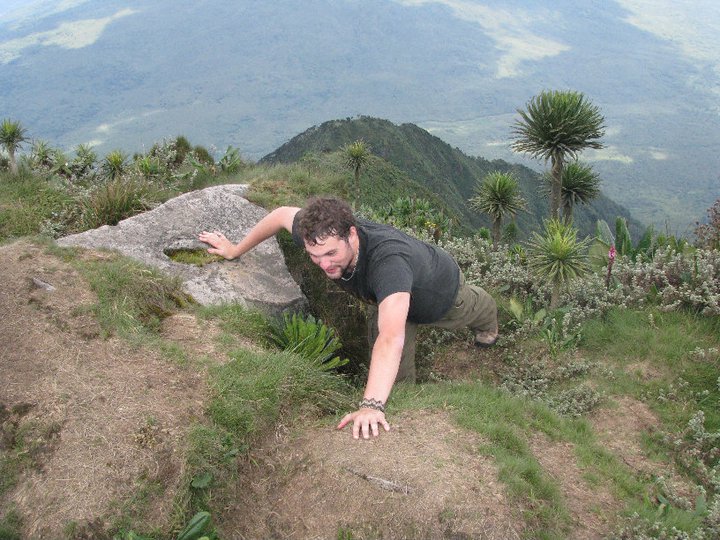

It is funny the type of things you fixate on while climbing though. For this paticular mountain I had altered the words to a song called 'Mansion of Misery', by unceremoniously editing Mountain into the title. However, I think the quote that was most predominant in my head was a gem from the second Jurassic Park move (Jurassic Park quotes seem to be becoming a running theme in this trip, much to my pleasure):
"Remember that chap about twenty years ago? I forget his name. Climbed Everest without any oxygen, came down nearly dead. When they asked him, they said why did you go up there to die? He said I didn't, I went up there to live. "
I have said before that mountain climbing is an enigma. This quote gives the gist of it. Although I didn't climb anything near to Everest, the effect is the same. The day after you can't imagine having spent your time anywhere else.
Other than that, everything has been fairly tame on the Africa front. About a week ago we walked out to lake Mutunda and were able to go swimming. I don't know if it is the elevation, but I could have placed this lake anywhere in Canada (ignoring the view). The water was beautiful, and the weather perfect. Although we were told that the lake didn't have Bilharzia, I'll have to keep my head up for any symptoms.
I guess the final piece of news is that a group of vets from Spain have rolled into town about a week back. There mission has been to set up spots where the local people can bring their cows, sheep and goats from deworming, as well as their dogs for the snip-snip. All to willing to help, Jess and I showed up at a field near our site one morning to get our hands dirty. What we weren't expecting, however, was for the vets to be delayed indefintiely that day. As a result, needles and other devices were put in our hands and we were sent to work.

Being the trained vet I am, I was immediatley in my element. Drench in hand, Jess and I quickly set to work on the goats and sheep. I guess the best way to describe the situation was organized chaos. As we worked to shove the stuff down the animal's throats, the children would already be off and running to jump and leap on the next group to get treated. Our arrival to a specific herd was punctuated by the bleeting of child-crushed animals, as a government official tried to record names at our torrid pace.

Once we had eliminated the smaller animals, we loaded up our needles of ivermec and stalked the real game. I was previously unaware to how savage deworming could be, but it really boils down to a lot of stabbing with big needles. As five or six local men draped themselves over the cows, we would do the honours of plungeing the syringes into the neck. Although the little cows often fell to their fate, more than a few times the big bulls would't stand for it and ran across the field full gait, with locals in tow like some bizarre trophy.
Later that day as I was walking home from a market, I was hailed down, and asked where I (the vet from spain) would be working the next day. It felt nice to be recognized as something other than a white person, but the irony was that I had no idea where the vets would be. Luckily, some thinking on the feet allowed me to tell the guy to listen to the radio! Saved.
That. That was a good day.
I think I have you all caught up, and must now leave (the internet place is closing). Tomorrow we are heading up to Bwindi for a few days, and then when we get back it'll be time to do some teaching in the schools. I think we are being joined shortly by two more Swedish volunteers; it is always nice to have some new faces.
Hope all is well, be good.
Much Love,
Sean
Fun fact: Congo was always my favourite location on the risk board, and I would secure it at all costs. I liked the name. Congo!Con GO! connnn goooo.
Subscribe to:
Posts (Atom)