Thanks for Visting


Hello. I'm Sean and I live in Japan. I'm glad you've come because I need you to do something for me.

Help me get up to no good by reading this > Challenge Mode! <

Sunday, April 17, 2011

Zanzibar and Safari Time

I apologize for being so hasty and vague in my last post, as I realize the famed Zanzibar deserves to garner a little more time and explanation than I gave it. However, I also would like to tell you about the four day safari I just took across the Tanzanian wilderness while simultaneously keeping this post short enough so that you will actually read it. Therefore I will now embark to fulfill all these criteria as well as I possibly can.


The night before we went to Zanzibar was spent trying to find an English pub in Dar Es Salaam. We had heard rumour through some means or another that this pub had the best fish and chips going; Arsenal also happened to be playing that night and we wanted to watch Premier football in an establishment that payed proper tribute to the leagues nationality. The only problem we faced was that we didn't know the name of the place. Small problem, right?

Somehow through vague hearsay from locals we got the notion in our head that the place was called the slip away Pub. Now the slip away itself in Dar is some fancy hotel on the harbour front, surrounded by a gaggle of choice stores; essentialy a strip mall on the waterfront. Knowing this, we were fairly confident that a pub could be hiding within the confines of the shopping area. That was the beginning of a very long and fruitless search, with everyone we asked pointing us in a different direction fifteen minutes walk away. With much frustration then, we finally ended up in a local place called the Q-bar, with the game thirty minutes old, and my want for a beer peaking.

The beer flowed. After the game (a disappointing draw from Arsenal) the sports bar miraculously shifted into a dance floor that had a live DJ and every song you've ever attempted at karaoke available for requests. No surprise then, we arrived back at our hostel late and rather intoxicated, and again no surprise that we walked to the port and boarded a two hour ferry journey in rather rough shape. It was the 'fast ferry' that we got on, but I still don't think it was quick enough for any of our likings. The Ferry, like every thing in Africa, would not be efficient if the management didn't take the opportunity to cram it full, well past the number of seats. Therefore, we spent the next two hour journey on the back deck by the engines, inhaling the fumes, feeling the pitch of the waves and keeping our eyes closed and breathing slow.

Landfall was sweet relief, and opting for the closest place, we made for the Bandari guest house - only three minutes walk from the harbour. Fun fact, Zanzibar has it's own immigration and you get another stamp in your passport for landing on the island; thankfully they didn't take the opportunity to charge you for another visa or something - although I'm surprised they don't. Bandari is a quaint little hostel, that much like all Zanzibar is a touch on the pricey side, with large rooms and complimentary breakfast. Luckily for us, they were willing to haggle the price down, but unluckily for us, across the road from our windows sat the local garbage container, full of trash and rotting fish, which always wafted in a nice smell when the breeze came from the ocean.


The shining gem of Bandari however was the TV for the guests to use, which was located just outside our room in the common area. Now I realize TV isn't much to get excited about, but aside from football in bars, I hadn't watched a thing since the first week of January. The three of us proceeded to sit in front of it well into the night, while watching such trash as top chef and wipe out. Brilliant programming!

The island itself is beautiful, and was a pleasure to explore. Zanzibar town is interesting, as it contains the widely known attraction of stone town which is then surrounded by a more sprawling and modern city. Stone town was a flashback to Lamu, with its close streets and maze like layout. It is missing the donkeys though, and instead has people on scooters and motorcycles zipping around the tight quarters.


Where Lamu has the advantage though, is with the street hawkers. The people trying to sell things near the ocean side in Zanzibar are so persistent and annoying that even if they had something you wanted you'd be inclined not to buy, just because they're too pushy. There is a fine line, and they all cross it. I had the same problem last night when I returned from safari and a guy I had never met was trying to get me to come to his hostel. If you spend six minutes pestering me after I just got out of a vehicle, gross from four days of tenting and dusty roads, I'm not going to cooperate with you, not a chance. And no, Zanzibar salesman, I don't need a scarf in forty degree weather, no it doesn't make it better if you give me three for ten, that just makes me warmer, no chasing me won't help. Know your target market!

Night time by the ocean is also very cool. In my last post I showed you pictures of the locals coming to jump into the waters at sunset. While this is going on, the local fisherman from the island congregate just down the coast and set up the nightly fish market. Every night all the fishermen set up grills and tables to cook up fresh all their catch from the day which they then sell to me, the tourist, at a marked up price. It is delicious. They have all sorts of skewers and chunks of who knows what sea creature, which they let you select and then take to the grill and cook in front of you. This was the first time I tried octopus, and it was actually pretty good.


From Zanzibar town we decided to head up the coast to the north of the island: Kendwa Beach. We decided to get there using public transportation, and with all our bags, climbed into the back of a dalladalla along with eighteen other people. The dalladallas are basically flatbed trucks with two rows of seats, open sides and a roof over top. Unfortunately for us it started to rain just minutes into our ride, and the powers that be lowered tarps down the sides, making the inside very dark and stuffy. I don't usually get motion sickness, but something about being in a closed space with the smell of eighteen locals and no air flow set my stomach off. Thankfully I didn't puke, and we managed to go about an hour and a half for 2000 shillings (roughly a $1.30). We later heard that people had taxied to Kendwa for as much as $40 American, suckers.

The main place to stay on the beach is a resort called Kendwa rocks, which fortunately also contains backpacker priced lodgings. This resort provided the building block for all the other resorts and the small town to crop up around. It was again fortunate for us that this happened, as food and drink was mind boggling pricey at our lodgings and we were able to wander just up the road for a more wallet friendly alternative. Aside from that, the resort contain a beautiful white sand beach, and the ocean was also a much nicer temperature than the soup near Zanzibar town.

After two nights we returned to ZT and decided to head back to Dar and move inland. The coast of Africa is beautiful, but it is over the top hot and the air is always about 100,000% humidity. Even if you're showering you're sweating, and life out from under the room fans is no fun. From Dar we decided to head to Arusha, the safari capital, and left early to the bus station to head out.

The ride from Dar to Arusha is a long one, and took us about ten hours all in. We arrived in the mid-evening and got off the bus tired and gross only to be assaulted by a horde of taxi drivers and safari totes. Much to their surprise, they couldn't understand why I was less than friendly while they were hounding me and pulling on me as I tried to get my bag out from under the coach. Jess, thankfully, had taken the time to map out where we would stay and it was a short walked from the station - we still managed to get no less than five cards from five people for the same safari company along the way though.

The next day we set out to find a well priced safari, and eventually made our way to no other than the place mentioned on the millions of cards we had been given the night before: meru treks. After surprisingly little debate, we had agreed to head out the very next day on a four day safari, which included Lake Manyara, Ngorongoro crater and Serengeti national parks.

We left early morning the next day and arrived out our campsite on a ridge overlooking lake Manyara just after noon. After dropping off the cook and the gear, we headed down towards the lake's national park, with cameras in hand and spirits high. The park by the lake was beautiful, and we managed to see all sorts of crazy African beasts, including many giraffes (possibly one of the strangest things going).


There was a spot by the lake where you could get out of the vehicle (at your own risk) and walk around near the hippo pond. It was a surreal field being on foot in an African park, as even though it seemed quiet enough, you couldn't help but wonder what was lurking around the next bush.


The next morning it was time to head into Ngorogoro crater, which in my opinion is one of the most beautiful places on this planet. The crater is a conservation area and not a park, and as a result the local Masai people are allowed to enter and graze cattle on the one side of the crater. As you can imagine, it was quite the site as you descended to see zebras, wildebeest and a man herding cattle all in the same field of view.


At the center of the crater was a giant lake, and as you descended, the mountains rolled up on all sides in breathtaking fashion, until all you could see was rolling plains spotted with large herds of animals and back dropped by green peaks.


We spent close to five hours in the crater, and in that time I managed to see the last one of the animals needed to complete the big five. The big five in Africa includes the leopard, lions, elephants, buffalo and the rarest of all rhinos. I was able to see all of those except the last during my safari in Uganda. Much to my pleasure then, at a fair distance, we had the luck to see two rhinos grazing!


Later in the day, as we were about to ascend from the crater and head to the nearby campsite, we made a quick stop at the only bathroom in the whole area. The bathroom is located in the only wooded area of the park, and featured black faced vervet monkeys jumping and playing as you walked into the facilities. As we were heading back to the land cruiser, our driver was looking very anxious and waved at us to "get in the car, quickly!". As we got in, he pointed down the road towards a lone bull elephant that was making its way up the lane towards us.

Turning on the vehicle, our driver took us over to the side of the clearing away from the elephant. The elephant instantly turned and again started walking towards us. Coming close, again our driver started the vehicle and tried to maneuver around the far side of the giant beast. That is when it charged! Hitting the gas and shifting like a madman, the vehicle just lurched out of the way as the giant animal came withing feet of charging the back end of the vehicle. We rocketed down the road in disbelief as the elephant gave a few meters of intense chase and with a trumpet of defeat, turned back. It was one of the most scary and awesome things I've ever seen.


That night we camped on a flat area located on the rim of the crater. The conservation area sprawled out underneath us as we had dinner and went to our tents to retire for the night. In the early morning was when I first could hear the hyenas. From what sounded like the edge of the campground, you could hear them communicating with each other in brief yelps. We're told they come for the leftover food, but I'm just glad they didn't decided to test the durability of the nylon tents.

The following day we headed to the Serengeti for the last two days of our safari. The Serengeti is also gorgeous, but in a much different way then the crater. The endless plains of grass seem to sweep off endlessly in all directions like a green ocean that you can't see the end of. Spotting the terrain is rocky outcroppings and lone Acacia trees that provide a change from the overwhelming vastness of the gigantic grasslands.

On our way towards our campsite we got very lucky. Seeing two land cruiser parked a ways away, our driver turned on his radio to find out what they were looking at. As we got closer, we got a very good look. Sitting in a tree, munching on something very much dead, was a leopard. Circling fifteen feet below him, waiting for the scraps, was a single hyena! Although the cars started rolling in after us, we had about ten minutes of really good viewing before the area was packed with cars and the leopard decided he was done. It is rare to just see them, let alone have them sit there eating in front of you! So cool.


One of the more inconspicuous animals on the Serengeti in terms of looks is the Cokes Hartebeest. However, with a name like that, I refused to believe that they were not being sponsored from the world power Coca-Cola. Therefore I decided to take the time to make this advertisement, and perhaps Coke will decide to reimburse me at a later date:


That night we stayed at a campsite located among a copse of trees. Much like the restroom station in Ngorongoro, the area was spotted with monkeys, and baboons coming in an out of the grounds was not uncommon. We even had the chance to see one of them turn on the facet and start drinking! However, I guess it had never heard of conserving water, because I was the one who had to walk over and turn off the water when he had finished. Just after night fall is when the lions first started calling out in the distance, and we went to bed with the sounds of the wild thick in the air.

Our last game drive was the following morning, and was no less amazing than any of the others. In the cool morning air, the sun was rising as we made our way around the park before breakfast. We managed to see another glimpse of a leopard, thousands of buffalo, packs of hyena and even a group of a hundred or so wildebeest running past - which we were informed was part of the great migration that is just beginning.

After breakfast we packed up and prepared to head back to Arusha. However, before we were free and clear of the park, we saw the one animal that I had wanted to see the most: cheetahs! As we were approaching the main gate out of the park, two male cheetahs were lazily strolling along the road, and did not seem at all concerned when we pulled up next to them. You can never take a bad cheetah photo, and I think I took too many. Such beautiful creatures, and definitely my favourite as a kid.


The rest of the trip was uneventful, and upon returning we were given free lodgings in maybe the nicest rooms I've stayed in in Africa. Unfortunately, apart from the free night, they were too pricey for our blood and we moved out this morning. Looks like Moshi is tomorrow, and with it a view of mount Kilimanjaro.

Sorry for the length,

Thanks for reading,

Sean

Sunday, April 10, 2011

Zanzibar

I don't, unfortunately, have the time right now to write another full post right this second. But, as my last post was so long and lacking any visual stimulis, I figure I owe you some pictures.


Zanzibar town (stone town) has a sea wall running around the coast. When tide is high in the evenings, all the local kids flock to the Ocean to jump off the sides!


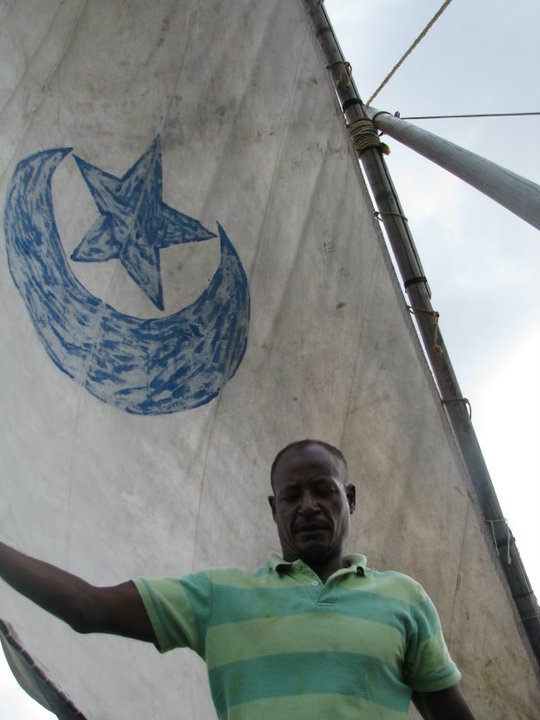
Traditional dhow that the locals use to move about. This one is similar to the one we went on in Lamu. Note the outboard engine on the back - pretty standard fair in this day and age.
Maybe my favourite picture of one of the locals jumping in. We had the luxury of joining them one evening - very, very cool experience.


This is a group shot of Jess and I with the two German ladies we met in Kenya, as well as a street child we somehow adopted that day. From left to right: Lena, Judie, Me, Jess and friend. Hope these pictures tide you over until I have the time to be a little more thorough. I really do apologize for the pure size of the last one, and if I can I will try and be more frequent and less wordy. Pictures are a bonus if the computer can handle it. Thanks for reading... er, looking? Much Love,

Sean

Friday, April 1, 2011

The Mysterious Disappearing Hostel


The remainder of our time in Nairobi was rather anticlimactic and dull. As the reputation of Nairobi told us *beware! danger!* much time was spent waiting inside a walled hostel compound for Brandon to arrive. Therefore, shortly after his landing in Kenya, Jess and I were eager to depart East towards the coast. Coinciding with our growing impatience, I had befriended two lovely German ladies (sisters, Lena and Judie) at the Nairobi hostel that were also headed in the same direction, and they provided added incentive to get a move on.

The night we grabbed the bus to Mombasa was cold and dreary. I'm generally opposed to night buses, especially after I got my fill of them in South America and double especially since the pace for this trip is fairly relaxed, and I'm not always saving my daylight for seeing things. Unfortunately for us, the cheapest tickets to Mombasa came with a night bus that left at 9 pm sharp (Ha! As if.) from the city center. Solemnly we rolled out of the city lights into the lightning splashed twilight of the rainy Kenyan countryside.

Now for most, I assume, night buses are probably a winning venture. Assuming you can sleep on a bus, you can get a night's rest, save a night's rent while traveling all at the same time. For me, however, I only manage to reap the last two of the benefits. Night buses bring me no sleep; time spent thinking instead, is how I fill the hours. Something about the pitch of a completely barren Kenyan wilderness can provoke deep thought in a person; compounded easily by a dreamlike waking state that results from the sleepless early morning hours.

Sitting there, watching dark shapes roll by the windows, wondering if it was a bush or elephant, I was lost in my head. Between futile attempts to sleep, I caught myself wondering on the purpose of travel. The back of a guide book I read in a hostel said: "We search, therefore we travel", but I'm left questioning the accuracy. What do travelers search for? It certainly can't be the short useless encounters with other travelers, or for photos of random landmarks, which are fleeting and meaningless - merely bragging rights against those left at home. Even worse, do we search for the longer friendships that travel can bring, which in the grand scheme hurt that much worse but last little longer? One theory is that we travel to see the difference. Traveling allows appreciation and understanding. One doesn't know what they have until they explore the alternatives. I'm still not sure, I'll keep looking into this one.

The bus arrived to Mombasa early the following morning. In total, I managed roughly thirty minutes of sleep during the whole ten hour ride, and even that near the end of the trip. In complete frustration I finally decided to lay myself down on the floor of the bus, which actually sort of worked, until shortly after the bus stopped to pick up a bunch of people looking to get a lift into the city. There went my extra seat and clean air. They were a particularly smelly group of individuals.

Once in Mombasa we immediately got hounded by a bunch of taxi drivers; after a little half-hearted and half-asleep haggling we agreed to pay way too much to be taken to a hostel called Mombasa backpackers. This place wasn't in the guide books, and we only knew of it because of the German girls we met were already there. The reason, we found out, was apparently because they had just switched to a location. Yet, this place didn't look or feel like a backpackers. The taxi after several minutes rolled out of town proper and out into the land of giant mansions with large fenced-in compounds.

At the gate, a masaii warrior in traditional garb let us in and we rolled up to the least hostel like hostel ever imagined. It honestly look like a million dollar mansion somewhere in the Hollywood hills. Also out of place were the proprietors of the place, a pair of (I think) gay lovers, one Peruvian and the other South African, who were nonchalantly smoking weed as we walked into reception (the living room?). For all intents and purposes it looked like two guys waited until the family of this house had left and then jumped the walls and started a hostel. Yet, rent was fair, the beds clean and the grounds had a pool - so we stayed.

Mombasa as a city is in my opinion, nothing special. We walked around the market district and found it to be much the same as all Africa - people will try and be your friend for your money. Along the coast, however, Mombasa is a pretty city. We walked by the old colonial fort (very expensive to enter) and through the old stone buildings of the coast. At one spot by the shoreline there was a rather picturesque scene of middle-eastern decent children jumping from a ten foot rock ledge into turquoise waters, while nearby the older men spent a lazy Sunday fishing the coast with a piece of line tied to their fingers. The breeze blew strong and fragrant off the Indian Ocean there, and for a long time I was content to just sit and exist.


From Mombasa, the five of us, as we had met with Judie and Lena, caught an early morning bus north along the coast to the island of Lamu. The bus ride was another seven hours, and the ferry out to the island thirty minutes on top of that - but the trip was definitely worth it. I'm not sure how widely known Lamu is outside of Kenya, but the word on the streets is that it is like Zanzibar, yet better as it doesn't get the traffic. I'm not sure how true this is, as there was a lot of tourists and have never been to Zanzibar (yet), but I deeply enjoyed my time there.


First of all, I'll start explaining Lamu by saying it is an island where many things are the same. Every man is the captain of a dhow boat, and for a 'fair' price, willing to take you snorkeling or diving or dolphin watching, or simply run you over to the next beach - it's the least they could do. Furthermore, everyone has a sister that does amazing works with henna tattoos, or a wife, but we were fairly certain that everyone's wife is another man's sister. Lastly, every man that doesn't own a dhow boat (which is very few), is instead a struggling artist that just wants to get by. They will have a backpack of their work on them and explain how they toil endlessly in their small houses to make their art, and again for a 'fair' price, are more than willing to offer me their services in creativity and shirt design.

In a less cynical tone, Lamu is indeed breathtaking. The old Islamic settlement hugs the coast closely, and features tall stone buildings and narrow street corridors. Indeed, the streets are so narrow that no motorized vehicles are allowed on the island (not exactly true) and instead the brunt of all transportation and labour falls to donkeys. In fact there are over four thousand of the beasts on the island, and one can hardly turn a corner without seeing two or three of them just standing and being.


The joke of Lamu is that you come for a day and stay for a month. Like most travelers, we laughed this off, and then fell right into the trap. I honestly think that part of the reason is that it is a pain in the ass to get there, and no one wants to hurry back to the dusty bus ride south. Moreover though, I think it is really just the intoxicating feeling of waking every morning with a view of the coast, and the taste of the salty air on your tongue. It truly is a beautiful island, and the real beauty in it is that it is small enough to be known to the hawkers after a short period - and they will leave you alone almost completely in a few days time.

We were obliged to do some of the touristy stuff, and over the week we were there we went on a dhow trip, snorkeled among the corals of the Indian Ocean, ate fresh fish on a boat near a long sandy beach and even ventured to hop on a donkey and go for a ride. I will say this in parting, the Ocean to some holds a magic of the soul, but almost subconsciously I always find myself wishing for freshwater when I swim in one.

~~~Interlude~~~

Sorry for the length of this blog, I am almost done. Let us finish:

After a drawn out and heartfelt goodbye, we finally summoned the courage and strength of will to leave Lamu. If you look at my last blog, you can take that as an indication of how little time I was really willing to waste while on that beautiful chunk of rock. From Lamu we set out to Malindi and there caught a matatu thirty minutes further south to Watamu, and ran into something we never expected: Italians.


It feels weird even to write this, but that specific section of the Kenyan coast exists in the orange hue of bronzer that exudes from the skin of Italians. Excessive hand gesturing and copious man thongs were indeed included. It was mind boggling to say the least. Little African children used to yell hello at me, and now enthusiastically sang Ciao in chorus. Stop it! Indeed, the presence of the Italians didn't just make the Muzungus annoying, but in turn the locals as well. As it was explained to me, Italians expect a a little banter, and as a result the salesmen got that much more aggressive and annoying. No dhows in Watamu, instead everyone has a glass bottom boat.

One neat thing we did do in Watamu was visit the turtle watch. The turtle watch is an organization that rescues injured turtles from the coast of Kenya and rehabilitates them back to health. On top of that, they monitor the local beaches for nesting sites and deter tourist vandalism as well as relocate nests that are in prone positions. By some stroke of fate and Brandon's mumbling of "we want to do things...", we ended up being put to work; cleaning the turtle tanks and doing a beach survey. We did however get to see two of the sick turtles, a green sea turtle and a hawksbill, which were both amazing. It is funny to say that the beach survey involved transects and other fun scientific methods, such that it felt like in a day in Watamu, I did more actual science than months in Uganda.


As we said goodbye to Watamu we also had to say goodbye to our German co-travelers, who by this point had been with us almost two weeks. This was a really hard parting, as I had spent a lot of time with them and became pretty close. Much like when Chris and Richard left us, we had to part with good friends unknowing of when we'd see them next. Bye Judie and Lena, I hope to see you soon.

From Watamu we went back to Mombasa, and immediately booked tickets south to Dar Es Salaam and Tanzania. From the bus station we hopped into a tuk tuk and headed back to Mombasa backpackers, which had proved a worthy enough hostel the time before. The tuk tuk brought us back to the gate of the compound and we paid him and sent him along before pushing open the heavy gate.

Immediately we noticed that the ever present door guard in masaii dress was missing from the little hut next to the gate - along with his craft table. Odd. As we moved further in we noticed more absences - such as furniture. Where was the patio furniture, the outside bar fridge and bar stools? Lastly, where were the people? The ever presents: the owners and the slow to leave travelers? Then the people came, out walked a Kenyan family: husband, wife and baby, and proceeded to stare at us with surprise and disdain. Who were these three uncouth travelers with large backpacks and the nerve to simply walk into their gated haven.

Where the hell did the hostel go? We sat outside the gate for the next thirty minutes trying to decide whether we had dreamed the whole place up in the first place. Then we started going over every fishy thing that had ever occurred there, like how when I asked if they were going to build a sign for their hostel, the owners immediate response was "probably not". Were they even real?

After much running around we finally managed to get rooms at dive called the Tana guest house. Although the staff was a little strange and the digs a bit shabby, when I woke up at 6am I could see my bus parked across the street, and that is pretty awesome.

I now write to you from Dar Es Salaam, Tanzania, and I don't know how to feel about it. Kampala was ugly, but endearing thanks to its energy and people. Nairobi was ominous and threatening, yet beautiful and metropolitan. Dar seems to have neither of these, it lacks the hustle and bustle to compete with Kampala, and is void of the pretty green space that begrudgingly made me kind of like Nairobi. I will remain for the time being, undecided.

Thanks for reading,

Much Love,

Sean

Friday, March 25, 2011

Lamu! Lamu! Lamu!

The sun is shining, the ocean breeze blowing, and the Sean smiling. Yet, why shouldn't I be smiling? It is hard not to when you are sitting on the edge of the Indian Ocean, soaking in the hot equatorial sun of the Kenyan coast. Maybe I'm a little burnt. Who's to say? Perhaps the salt from the bath like waters makes me itch a bit; minor problems.

The point is, this is not a new blog. This is a tease.

Brandon, the recently arrived, and Jess along with myself are in good company here on this little island of paradise, and as a result have chosen to live it up.

My proper blog will be soon. Maybe when I'm off this rock? I'll tell you about night buses, Mombasa and this little slice of paradise called Lamu.

Be good.

Sean

Tuesday, March 15, 2011

Kenya Dig it? Nairobi vs Kampala, and other news.


As you may have guessed, the time for Kenya has arrived. However, unlike the way we did Uganda, we're starting in the city first. Sunday morning, awoken at 5:30 by the call to prayer of Kampala's ever-too-close-to-our-hostel mosque, we packed and set out to catch the bus for our first long overland bus trip of Africa.

Setting out for Nairobi at just after seven in the morning, we rolled in roughly thirteen hours later just as the dark was settling. This may just be a pet peeve of mine while traveling, but I really detest entering into a new city after dark. But unfortunately, like Kasese, Jinja and Kampala before it, Nairobi became another city of twilight. There are many reasons for this dislike, but the main one is that I have a very hard time getting a proper feel for a city when the sun goes down. Everything in what could be an otherwise friendly place seems to gain a sinister quality that is just off putting.

Thoughts on Nairobi: It becomes apparently very quickly that Kenya is a country of considerably more wealth than its East African neighbors. The city center is clean and beautiful, with many green filled parks and looming skyscrapers. Prices for things are also a lot more expensive. At times walking through the downtown I felt as if I could have been in a part of Toronto on a summer's day.

The bad thing about Nairobi, sadly, is that reputation proceeds it. Outside the core of the city exists slums and poverty. The sinister quality of Nairobi after dark is more than just a trick of the mind in a lightless world. Crime is common, muggings frequent and vigilance required. It is unfortunate that a city with so much potential beauty is at the mercy of the economic divide that exists all over Africa. The ultimate result though, is that Nairobi gets the reputation of being boring. Taxis are expensive and the night life is dangerous; tourists can't be bothered or hesitate to really take in the city, and end up sitting in a hostel waiting for bed. Shame.

In stark contrast to Nairobi, is the vibrant nightlife of Uganda's capital: Kampala. Kampala is bonkers. My first look at Kampala was on a pass through on our way to Jinja from Fort Portal. Catching a late morning link bus from Fort Portal, we arrived in Kampala just around early evening, and set out on foot from the bus terminal to the taxi park to grab a matatu to Jinja.

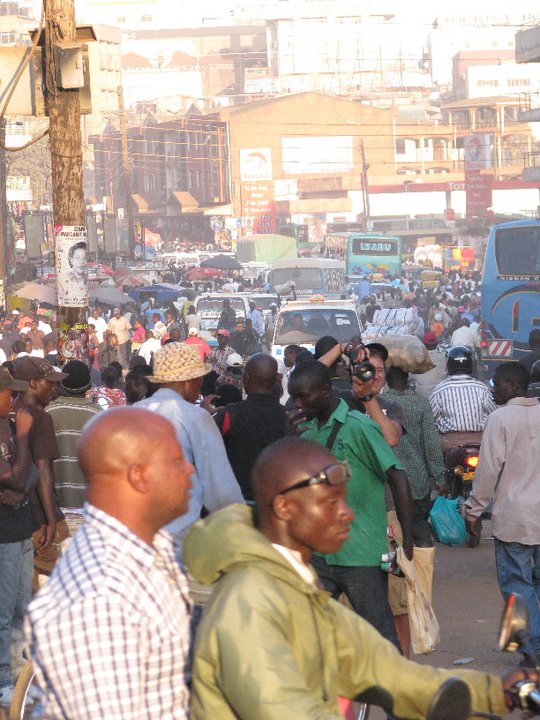
Picture Kampala and its taxi park like this: You're walking in the woods and you hear the distinctive sound of a hornet's nest. Grabbing the hornets nest, you lay it on the ground and look around for a big stick. Upon finding that stick, you smash the hive repeatedly and watch the wasps swarm about you. Now instead of wasps, picture yourself on a dusty city block and people are swirling about you in like fashion. Most are in a hurry, some are trying to sell you crap and others just look lost and mill about. It is bonkers! There are literally hundreds of taxis, honking and strewn about the lot. Vehicles move by continually, opening and closing gaps in all directions; as you try to walk the world around you is turned into a shifting labyrinth of noise, metal and exhaust. The only thing more intense then walking through it is attempting to boda the streets during rush hour. Holy crap!


Link to a photo of the Taxi Park


Kampala proper is no less amazing. Take all the aspects of rural Uganda and drop them on a more built up metropolitan background and then magnify it 100 fold and you'll find yourself in Kampala. Markets spring up on all side streets, vendors spread cloths with their wears on the side of busy avenues and noisy children ask for your money. Yet, simultaneously behind it, fast food restaurants and fancy hotels exist, patronized by portly city dwellers; showing the first signs of people living in excess that I've seen in all my time in Africa.

At night the bars and clubs of Kampala light up, and keep going until late the following morning. In our escapades, Richard, Jess and I found ourselves at a small bar on a side street of Old Kampala that was actually featuring the rarity of live music. Already fairly intoxicated, we stormed the dance floor to find it deserted among a sea of seated watchers. Unhindered by the inhibitions of our sober audience, we tore it up, many times challenging the people in chairs to join us. Within a short time, obviously jealous of our fun, we managed to get the whole bar on the floor. Such was our enthusiasm that about an hour later as the band winded down its set, a round lady who had been working the bar came about the floor and pressed into our hands a coin. You heard me, I got paid to dance. A whole 100 shillings. I figure that to be about 4¢. Kampala is pretty awesome.


Aside from that, the only other big thing we've done in the past couple weeks has been our white water rafting of the Blue Nile in Jinja. Unfortunately the cafes in Nairobi don't seem to let me put up pictures, but anyone with Facebook access to Jessica or myself will see that there are a couple pictures up (mom and dad, ask Kase to show you!). The day that we went was beautiful, and the stretch of river was between 30 and 40 km. And, even though over that stretch there was only about ten rapids, the water was so warm and nice that during the calm periods we'd lay about in the river and take turns flipping into the water off the raft.

Not much is new besides that. We spent a little bit of time at the crater lakes near Fort Portal that were crawling with monkeys. That was pretty neat, as when you were eating or walking back to your room, colobus monkeys would be within arms reach, playing, fighting and making noise.


Currently we must sit in Nairobi for a couple days yet. Our English friends that we've been with for the past two and a bit months are flying out tomorrow for the north of Africa, and Brandon comes into Nairobi on Thursday. From here all signs point to Mombasa or Lamu which both lie out towards the coast of the Indian Ocean. Our time in Kenya will probably be only a few weeks, and then we'll head south to Tanzania!

Thanks for reading,

Sean

Thursday, March 3, 2011

This Post is Late... but, I saw a Leopard!


When blogging is going smoothly, and updating is consistent, the act of writing these posts can be a lot of fun, and quite relaxing. However, whenever I am actually busy enough to find myself postponed from posting, and activity and excitement is omnipresent - then blogging picks up an annoyingly frustrating quality. To be specific, the longer I go without posting, the more content I have to sift through to decide what is important of the everything that has happened. So, with much deliberation, I feel like I have made a suitable list of the essential points in regards to my goings on of the past couple weeks:

This is going to be long.

In my last post, I left you by saying that we were getting ready to have a goodbye party. However, unlike most goodbye parties, this one was to feature outfits composed of trendy buys from the Kisoro market place. Not much needs to be said. Things got messy. In a vote for best dressed, a tie was announced between Richard and Darja.

Richard, standing on a chair at one end of the table, was sporting the ensemble of a decade long past. His bright purple, sleeveless, nylon vest was glistening in the moonlight, while underneath it, just poking through the unthreaded zipper was a t-shirt that clearly said "Desert Storm, these colors don't run!" while a gaudy flag waved patriotically below.

Opposite him, posing proudly on a chair at the other end, was Darja. The best I can describe the dress she found is like a slap in the face. I'm not sure what earthly beast puked up this ribbon adorned chunk of fabric, but apparently that same beast donated it to Africa - because it was for sale at the market. The joke we made was, unfortunately for her, that it was standard Slovenian Sunday best, and she violated competition rules by bringing it from home.

After a close call, Darja won. The competition was pretty irrelevant, because everyone got equally destroyed, but an honourable mention goes out to Mike, who managed to assemble a 'classy' looking suit and touched it up with ladies plastic shoes.

After the party, and before we left Kisoro for good, we managed to clean up the last of the Ugandan Virungas. Mt. Gahinga, the smallest of the volcanoes in Mgahinga national park, was the last of the three for us to climb - and we didn't feel right to leave a job unfinished. So with much planning and hum-haing we set off early on our last day at the park to complete the set.

Gahinga lacks the sheer size of Muhavura, and the novelty and beauty of Sabinyo, yet seems to have forged its own identity that is just right. The climb up was rather nondescript, reminiscent to the beginnings of Muhavura in how it was a steep climb through bamboo forest. Our guide made us stop a bunch of times, but my least favourite among them was when he wanted to show us a hive of African honey bees. As he stopped us to see the bees, he simultaneously parked us over a nest of fire ants. About the time that people started jumping around to get the ants out of their pants, was when I got stung in the head. At least we made up some lost time as we spent the next five minutes running up the hill.

However, regardless of some of the climbs' lesser points, waiting at the top of the modest 3400m summit is a rather pleasant little swamp. It seems almost absurd to find it up there, as it is just so out of place for a mountain top, but it did allow for a string of beautiful and goofy photos before we had to start back down. This climb also marked the start of my cough.


Later that evening, we said our final goodbyes to the town and district of Kisoro and headed off in a private cab towards Kibale and Lake Bunyonyi. Thinking myself pretty smart, I managed to walk off with a pretty neat souvenir. I found out through rumour and hearsay that Ugandan flags were purchasable at the local school supply outlet, and went about getting all the staff at the the community camp and the hostel to sign it. I'm not sure why, but they all seemed so thrilled to just be allowed to participate in something so simple. They felt good, I got a really neat signed flag.

Arriving in Kibale around 9 pm, we checked into a classy little hostel called the Edirisa. The Edirisa contains a cultural museum that it claims is the purpose for the building - but as far as I can tell nobody goes to it. That evening we had a meeting with some Slovenian contact of Darjas' who had arranged to hook us up with a canoe trek around lake Bunyonyi on the following day.

My feelings about the trek are mixed. First off, the normal 90,000 Ush price tag was waved for us as we were to be guinea pigs in the planning of a new guided trek. This was good. However, I've found out in the past bit that I don't have the stomach for contrived, heavily guided 'cultural tours' that are basically human safaris. Furthermore, the title of one day canoe trek is a little misleading, as we spent less than one of the nine hours in the canoe. This meant that there was about eight hours of hiking around a lake, the day after I climbed a volcano, and with a cough that was worsening. Those are the downsides.

The tour started bright shiny, and we were to leave the hostel by no later than 8:00 am, so that we'd have lots of time to make it to the lake from Kabale for the 9 am start. Promptly at 7:15, with a menu promising faster than normal (15-20 minute) breakfast wait times, I ordered my breakfast: eggs and sausages. At exactly 8:15 am, still without breakfast, the waitress, Agnes, returned to tell me there were no sausage. I went without breakfast, hurray!

Leaving the launch site at 9:30, we headed across the bay to the landing site; and the started of our 8 hour trek over land (sans canoe). Stops included a sing song at the local nursery school (really fun), a lecture from a local healer (75% of his random bag of plants were anti-witchcraft) and finally weird lunch and craft time from a local family. Although the healer was a laugh, the crafts time was actually a bit of a hoot; but not because I did any crafts.

While everyone was trying to weave silly bracelets, I was lying off to the side in the sun, unknowingly making myself a target for pillaging by the children. As I was looking through some photos I had taken, one of the girls started reaching for my camera with her grimy hands and quickly relieved me of it.
Once that had happened, everything on my person became fair game, and my sunglasses were quickly confiscated. Then, once they learned that my sunglasses were obtainable, they went off and took EVERYONES sunglasses. I created monsters. However, the one that yoinked my camera did take some cute shots before I managed to relegate it back to proper safety.


After another quick spin in the canoe on turbid waters, and a dinner consisting of the best crayfish masala ever made, the day was under wraps, and we were taken back into Kabale. Not yet satisfied with the lake, as our introduction was under artificial pretences, Jess and I decided to head back out the next day and live it up a little bit. Using bodas, we flung our full packs over the handlebars and chugged back out to Bunyonyi in the early afternoon. The hostel we chose was a small little place called crater bay cottages. We were trying to meet up with Mike and Richard who had headed out the day previous in lou of the canoe trek, and that was the spot they told us to meet them.

Crater Bay cottages, as the name suggests, contains cottages - which were the first things that the reception staff tried to entice us with. After a price tag of 64,000 was stated, we assured them that it was in their best interest to think cheaper.

"We have tents for 15,000 a night"
"Um. Ten thousand?"
"..."
"..."
"OK."


So that is how Jessica and I ended up staying in Ugandan surplus army tents for four nights on the side of a lake. It is just a funny coincidence, as it turned out that Richard had a similar conversation the previous day that went something like this:

Staff: "Rooms are 15,000 a night"
Richard: "Anything cheaper?"
Staff: "You can have the discount, but you have to ask for it."
Richard: "Can I have the discount?"
Staff: "Yes, we can give you the room for 10,000"

It should be this easy everywhere.

Lake Bunyonyi is one of many freshwater lakes in Uganda, but unlike so many of the others, it is free of the ever-unfun Bilharzia worm, and is interestingly enough the deepest lake in Uganda; second deepest in Africa, and third in the world, as we were informed, measuring somewhere near 6,500 feet deep. One fun sign on the side of the changing room informed us with an extra zero and an ominous skull and cross bones that the lake was in fact 65,000 feet deep and that swimming was at our own risk; so 'pliz' be careful. This sparked many fun debates as to what may exist at the bottom of a lake that punctures the mantle of the earth.

Everything was not all fun and games though, as my cough had developed into a full blown cold by our second day in the district. I wish cold was accurate, but in reality I felt more like death warmed over. When we went for dinner the first night, I found myself mid-evening lying on the dock shivering while the others played pool. The real scary part is that when I went through the checklist of symptoms, 90% banged head on with the onset of malaria. Fearing for my well being, I did the only thing possible from a man at a resort in a region with terrible health care: I relaxed and swam and drank my heart out until the sickness had no other option than to accept defeat and realise it would not ruin my good time.

Four days and one massive night later, I was feeling a lot better. I'm pretty sure I just picked up some crazy African flu bug, and even now I still have some remanent of the cough. Amen it wasn't malaria though.

As we packed to leave the lake, we began planning for our next destination. The consensus of the group was for us to head up to Queen Elizabeth national park, and we agreed to travel to Kasese, where I am currently writing this. The problem with Kasese however, is that no guide book likes to tell you how to get here, or vaguely references it as impossible. As a result, it took a lot of asking and searching before we managed to get dropped off in the taxi park next to a minibus that we were assured was heading this way. Spoiler alert, it was.

Though there was no surprise in the trip as far as unwanted destinations go, the surprise came from the vehicle itself. These minibuses are nothing spectacular; containing four rows of seats, each with a fold down jumper seat such that approximately three riders could be on each bench, the estimated number of total passengers for a fully loaded bus is twelve. The ride was only 160 km, which should take about 3-4 hours, and if it didn't stop much, we'd get there quickly.
Reality Check: Mid ride we had an estimated twenty six people in that glorified van. The total travel time was about seven hours. We stopped for EVERYTHING.

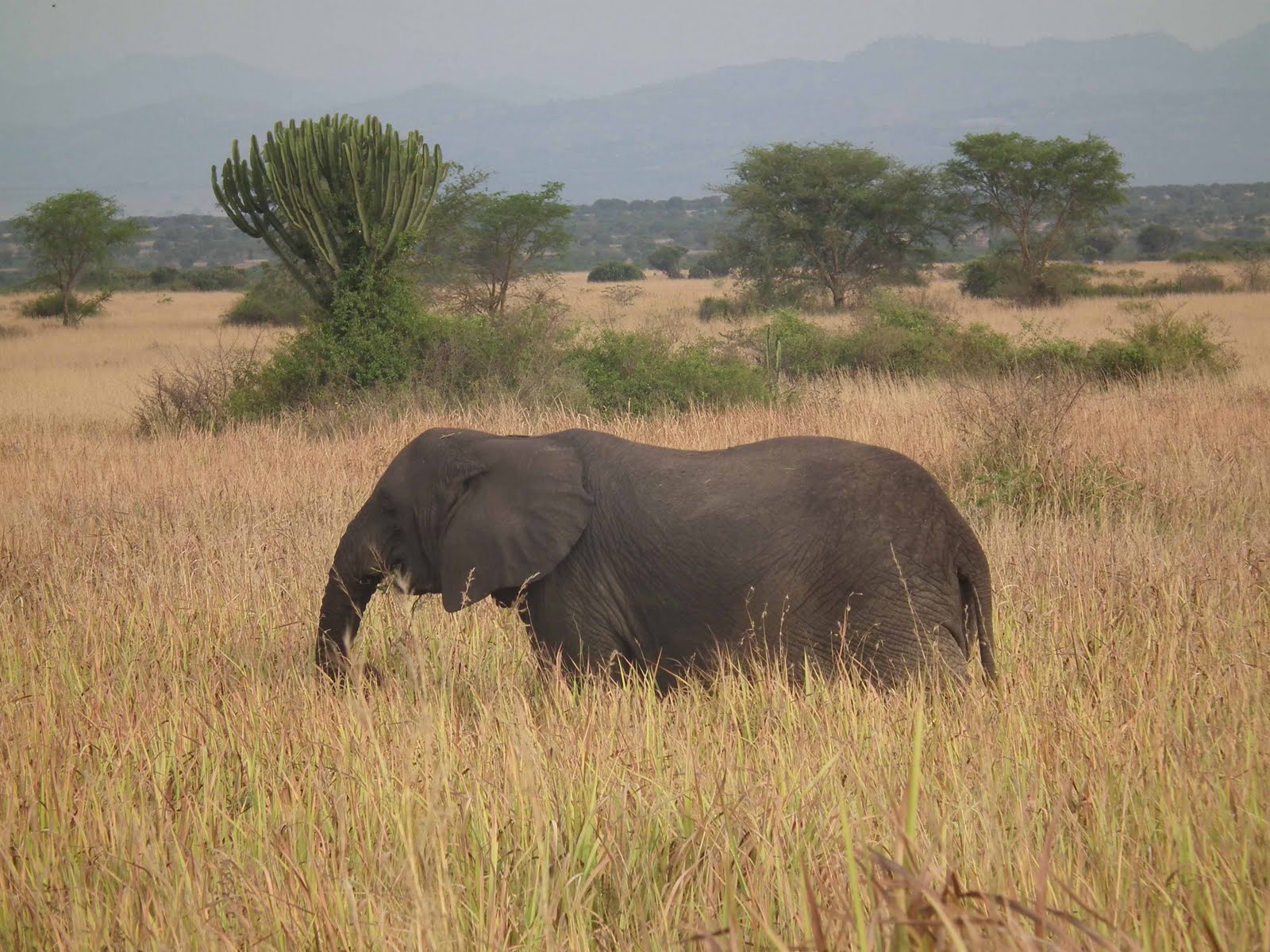
Forget it, Kasese time! Kasese is a town that I would say is fairly typical of what I am coming to expect from East Africa: couple roads, handful of banks, power intermittently and a grocery run by an Indian man. The big difference? The big different between Kasese and every other place I've been to so far is that it borders on Queen Elizabeth national park; the first park to fit my stereotypical view of Africa as sweeping savannah plains spotted with trees and copious wildlife. It is awesome. Even as we were driving across the park to Kasese in our wheeled sardine can we almost hit an elephant! COPIOUS, CONSPICUOUS, UBIQUITOUS WILDLIFE!

No surprise then, that we were quick to head out on safari. This morning at 5:30, picked up at our hostel by a driver, we headed out into the park for our day of awesome. Five minutes down the road, in the distant glow of the head lamps, our driver claims to have seen a lion. We're ecstatic! We haven't even left the public paved road cutting through the park, and already we have lions! But then:

Driver: "Oh! No, no! Not lion! Leopard!"

Sure enough, as we drove closer, it was a clear as day leopard stalking along the side of the road. Unfortunately I was unable to take a picture due to the lighting, but car or not, I was all of ten feet from a sweet big ol' kitty. After a little bit of head light on/off cat and mouse it finally decided to take its leave of us; but the tone for the day was set. When you see leopards five minutes in, the rest is gravy.

Sure enough, the rest of our early morning safari game drive proved fruitful. We saw a herds of cobs and buffalo, scampering warthogs and a lot of lions. The highlight after the leopard was a particular male lion. His back leg was lame and he was separated from his pride, as if he had been cast out. To add to his misery, he was being harassed and chased endlessly by a single hyena, which pursued him around a bush and out of site.

After the game drive, we headed further into the park to a section of forest that reminded me exactly of the Amazon in South America. While there we managed for a reasonable price to track and ultimately find chimpanzees. Although I loved seeing the gorillas, this trek made me resent that whole ordeal (look at my blog called Gorillas! for clarification). For 1/10th the price and 1/3 the time commitment I was able to spend an hour with another of the worlds great primates. They are truly amazing beasts.

To round off the day we proceeded back towards Kasese and entered the plains area of the park near the channel between Lake George and Lake Edward. For a reasonable price, we managed to book a boat safari up and down the channel between the two lakes. It was here that we got to see the giants of the waters; hippos and crocodiles were around in an endless abundance. I never realized that hippos existed in such numbers, but my god, they are everywhere!

On the drive back to town we were reflecting on out days viewings, and lamenting on the fact that the only thing we really didn't see many of were elephants. We pleaded with our driver to take us to a spot with elephants, and he acquiesced to take us to the one spot he knew where they liked to go to drink. Sadly, there were none there, and we headed back to town in defeat. That was until about ten minutes later, when the driver slammed the breaks and excitedly squealed: "Elephants!". True to his word, on the side of the road, ten feet off, eating the grass, was a herd of elephants. I'll say it again, when you start with a leopard, everything else is gravy.

With the exception of a quick stop at the equatorial line, that essentially brings you entirely up to speed. The line is pretty non-descript, just a little sculpture saying "Uganda's Equator' but apparently the placement is so precise that water spinning out of a bucket will be in different directions on either side, and straight in the middle.

Heading to Fort Portal tomorrow, lets see how many we can get in the bus!

Thanks for reading,

Much Love

Sean